
A lot of businesses out there just lump SEO and digital marketing together, right? Like they’re the same thing. But that muddled thinking honestly, it gums up their budgets, leaves folks with totally unrealistic expectations, and just builds some really flimsy marketing setups. I mean, you see companies hire an “SEO expert” and then they’re just sitting around, waiting for instant leads to pour in from social media. Or another business starts dumping money into paid ads, assuming that’s them “doing SEO.” Honestly SEO is only one part, and most times it’s that pretty specific piece, of the entire digital marketing pie.
The companies really pulling ahead and seeing massive growth by, say, 2026? They get it. They understand this distinction cold. They know exactly when SEO is the play for that slow burn, long term visibility and when they should lean on wider digital marketing channels too, to reach people faster and really convert them.
What is the difference between SEO and digital marketing?
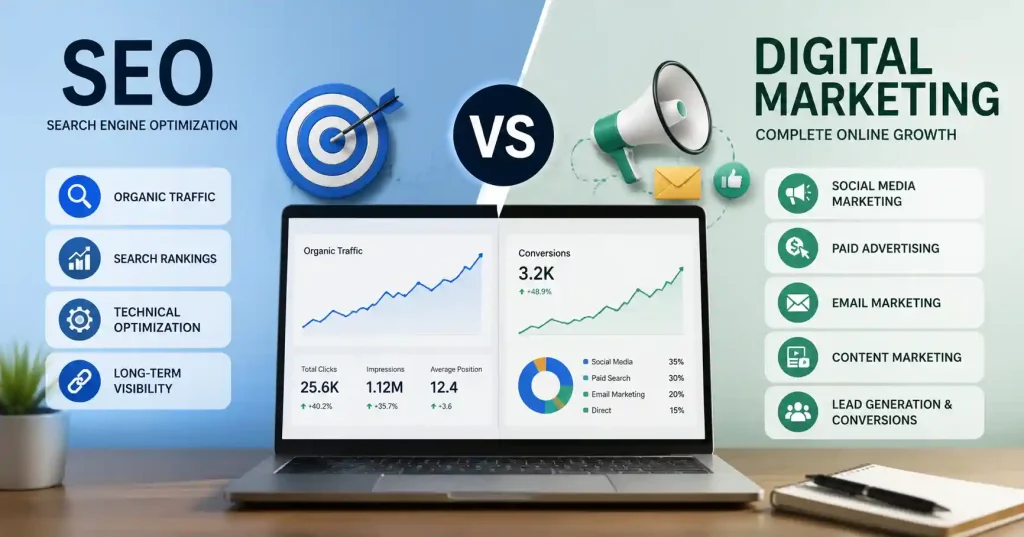
The difference between SEO and digital marketing is that SEO, is more about increasing your visibility on search engines while digital marketing is the bigger umbrella for all online promotional work. For example it, includes SEO as well, but also things like social media, paid advertisements, email messaging, content promotion, and even conversion optimization. In plain terms, SEO is more like a component in the broader digital marketing image , not the whole picture by itself.
SEO is one branch inside the larger digital marketing ecosystem.
Think of digital marketing as a complete business growth system. SEO is one strategy inside that system designed to attract organic search traffic.
For instance, when someone is searching for a best digital marketing agency near me, and they end up finding your website organically, well thats SEO. And when you plan Instagram promotions, email nurturing, YouTube videos, plus retargeting ads all inside one single strategy then it turns into digital marketing.
This difference really matters because businesses often think that SEO alone can somehow take care of branding, lead nurturing, customer retention, and even social engagement. It cannot do all those things, not by itself.
Clear takeaway: SEO is a component of digital marketing, not a replacement for it.
How does SEO fit inside digital marketing strategies?
SEO supports digital marketing by helping you build a long lasting organic presence, real credibility, and steady search driven traffic over time. It usually works better when it s stitched together with content marketing, conversion optimization, and customer retention systems, rather than when it is left alone, sitting quietly for weeks.
One mistake that small businesses often make is treating SEO as a single separate task. They keep publishing blogs but miss the landing page conversion piece, forget the email follow up, and downplay customer trust signals too.
A smarter approach connects SEO with the full customer journey.
- SEO brings visitors from Google
- Content builds trust
- Landing pages convert visitors into leads
- Email or WhatsApp follow-up nurtures the lead
- Reviews and testimonials strengthen credibility
- Retargeting campaigns improve conversions
This is why SEO works better inside a larger strategy.
If your website content structure is weak, improving your pages using this on page SEO checklist can strengthen the SEO side of your overall digital marketing strategy.
SEO vs Digital Marketing Comparison Table
Both SEO and digital marketing help businesses grow online, but they differ in goals, channels, timelines, and execution.
| Factor | SEO | Digital Marketing |
| Main Focus | Organic search rankings | Overall online growth |
| Traffic Source | Search engines | Multiple channels |
| Cost Structure | Mostly long-term investment | Mix of organic and paid |
| Timeline | Slower but compounding | Faster depending on channel |
| Channels Used | Google and search engines | SEO, ads, email, social, video |
| Goal | Increase organic visibility | Generate awareness, leads, and sales |
| Metrics | Rankings, clicks, traffic | Leads, sales, engagement, ROI |
Bold takeaway: SEO brings organic visibility while digital marketing manages the complete customer acquisition journey.
Many businesses think running Instagram or Facebook pages automatically means they are doing SEO. They are not. Search engine optimization specifically targets search visibility and rankings.
Google’s own documentation on search optimization explains how search engines crawl, understand, and rank content through its SEO Starter Guide.
Clear takeaway: SEO focuses on discoverability in search engines while digital marketing handles broader online growth.
Which is better for small businesses: SEO or digital marketing?
Small businesses shouldn’t pick either SEO or digital marketing. Instead, they should use SEO as a piece of a wider digital marketing plan, depending on the budget , the objectives, and the whole buying cycle.
If you need leads right away, paid campaigns plus social media can bring faster exposure, sometimes almost instantly, too. Yet if your goal is lasting organic visits and less dependence on ads, then SEO really should be in the mix, not just later.
For example:
- A local clinic might benefit from tweaking its Google Business Profile and doing SEO, it can bring more visits and less wasted effort, right.
- An ecommerce brand could mix SEO with influencer campaigns and retargeting ads, so the message sticks longer, even when people already left the site.
- A coaching institute may put together YouTube content, SEO blogs and then WhatsApp nurturing paired with email automation, so leads stay warm and responses land more consistently.
The biggest misconception is expecting instant outcomes from SEO. SEO compounds gradually, like it builds quietly in the background. With digital marketing channels, like paid ads, you can pull faster traffic in, but it also means there is always ongoing spend, no breaks allowed.
This is why balanced strategy matters.
If your goal is increasing organic traffic without depending fully on paid campaigns, this guide on how to increase website traffic without ads supports the SEO side of digital growth effectively.
Clear takeaway: Small businesses grow faster when SEO supports a broader marketing system instead of becoming the only strategy.
What are the biggest misconceptions about SEO and digital marketing?
The biggest misconception is that SEO means fast rankings while digital marketing means instant sales. Both ideas are incomplete and a bit misleading, because people just assume.
SEO is not only adding keywords into blogs. Digital marketing is not only running ads or posting reels, or whatever channel looks loud that week.
Many businesses also underestimate how much conversion optimization really matters. A website can end up ranking well, but still fall flat because the landing page is weak, trust indicators are absent, or the follow up process is slow.
Another misconception is that traffic equals success. Quite a few companies push more visitors, yet they don’t improve leads or sales because the traffic is not qualified, like it does not match the buyer intent.
For example, a small service business put a lot of money into Instagram content, but received very few enquiries, at first. After it updated the SEO pages, added reviews, improved the location pages, and also refined the WhatsApp follow up, the conversion quality jumped a great deal. This happened even though the total traffic level stayed quite similar.
The lesson was simple. Better traffic matters more than bigger traffic.
How should businesses combine SEO and digital marketing in 2026?
Businesses should blend SEO and digital marketing together by setting up one connected customer journey instead of juggling disconnected channels, because the user experiences it as a single uninterrupted flow not as separate fragments.
Here is a practical framework.
- Use SEO to attract high-intent search traffic
- Use content marketing to answer customer questions
- Use social media to increase visibility and trust
- Use email or WhatsApp for follow-up
- Use reviews and testimonials for credibility
- Use analytics to improve conversions continuously
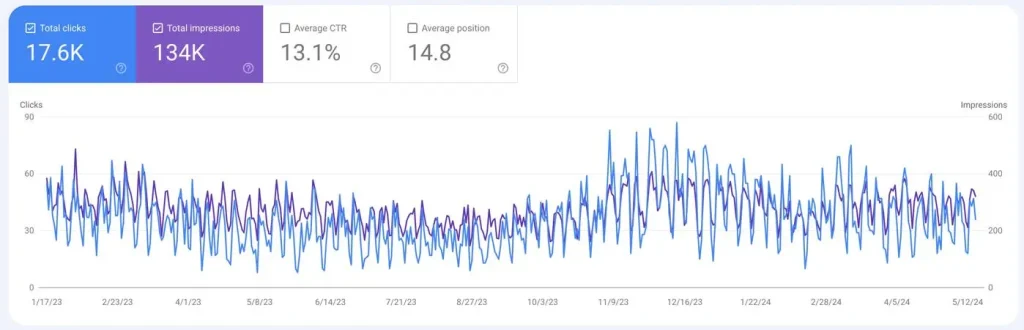
Businesses that combine these elements create stronger long-term growth systems.
A Google Analytics or Google Search Console dashboard showing growth in organic traffic, impressions conversions, and engagement, after we combine SEO with the broader digital campaign stuff. It should look a little smoother overall, like more qualified clicks and better user behaviors, even when we track it across multiple reports, not just one.
Final Thoughts on Difference Between SEO and Digital Marketing
Difference between SEO and digital marketing, explained simply, is basically specialization versus a wider system.
SEO helps folks find your brand through search engines, the way people stumble upon it when they look. Digital marketing helps a business draw in, nurture , turn into buyers, and keep customers, all across lots of online channels.
One builds organic discoverability. The other builds the whole, online growth setup.
When businesses grasp that distinction, they make wiser investments, craft steadier customer pathways, and they avoid overly optimistic assumptions from only a single channel.
Clear takeaway: SEO is one of the strongest pieces inside digital marketing, but real business momentum happens when each channel coordinates together.