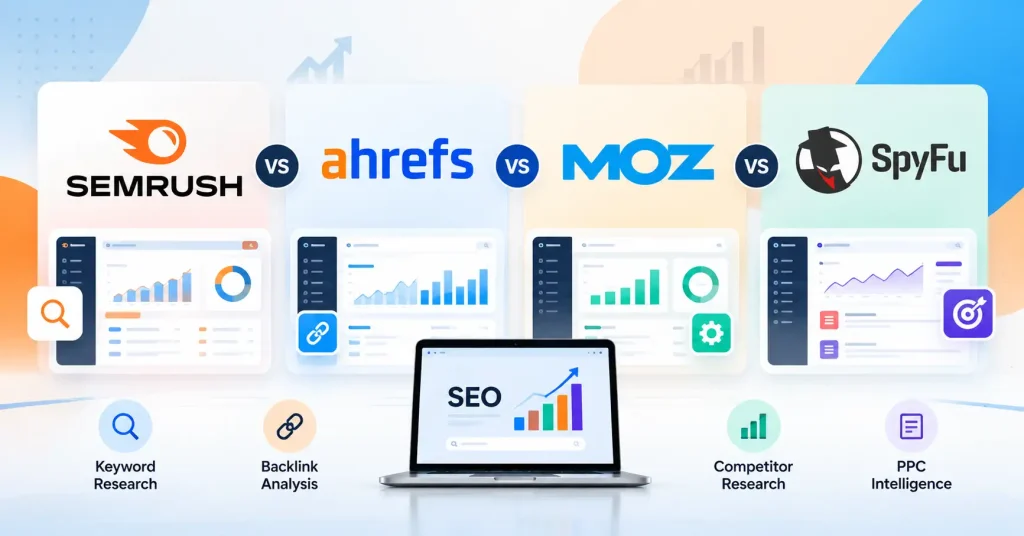

Picking an SEO platform? It is not just about grabbing the one with the most bells and whistles. Sure, Semrush, Ahrefs, Moz, and SpyFu all cover the basics, like digging for keywords, keeping tabs on rivals, and tracking your search standing. But they approach search marketing from completely different angles. The crux of any debate between these tools boils down to a simple question. Which one actually aligns with the daily tasks you are trying to accomplish?
Picture a content crew hunting for fresh ideas. They need something worlds apart from an agency stuck doing technical audits for a gaggle of clients across multiple continents. What about a company pouring money into Google Ads? They might get way more mileage out of heavy duty ad intelligence instead of a massive backlink repository. This guide maps out each platform’s sweet spot and its flaws, it shows you when one becomes the clear frontrunner, leaving the rest behind.
Semrush vs Ahrefs vs Moz: What’s the Difference?
Semrush sits out there as a broad digital marketing suite. Ahrefs, on the other hand, built its name on organic search, backlinks, keywords, and digging into content. Moz zeros in on core SEO tasks. SpyFu zeroes in on rival research for both paid and organic search. That split matters. Why? Because these platforms step on each other’s toes constantly. You can dig up keywords in all four, track rankings, spy on competitors, and check out sites. It really comes down to the friction point, Which workflows feel effortless on which platform? Take an SEO consultant. They bounce between keyword research, technical site audits, competitor sniffing, content mapping, and client reports all day long. A paid search specialist, they mostly want rival ad histories and PPC keyword data.
Semrush: Broad SEO and Digital Marketing Workflows
Semrush is designed for teams that want SEO alongside other marketing activities. Its toolkit extends into areas such as keyword research, technical SEO, competitor research, content, PPC, local search, social media, and AI visibility.
Pros of Semrush
Semrush shines brightest because of its sheer breadth. Instead of juggling a dozen niche tools, your marketing team handles most research and reporting inside one roof. That is a massive time saver. Plus, it really pulls its weight when SEO strategies and paid ads overlap. A marketer researching a commercial keyword can examine organic competition and then investigate the paid search environment around the same market.
Its technical SEO workflow is another practical advantage for agencies and in house teams managing active websites. Site audits can help identify crawlability, metadata, linking, and other technical issues that need attention.
Cons of Semrush
The breadth can also become a drawback. There are many tools, reports, filters, and metrics, and a new user can easily spend time learning the platform instead of acting on the data.
Sometimes it is simply too much software for a tiny site, Do you actually need a massive marketing suite? Hardly, if you merely check keywords or backlinks once in a while. Save your cash.
Best use cases for Semrush
Semrush is particularly useful for:
- Agencies managing several SEO and digital marketing workflows
- Businesses combining SEO and PPC research
- Competitor and market research
- Technical SEO audits
- Content teams that want SEO and content workflows together
Ahrefs: Deep Organic Search and Backlink Research
Ahrefs is particularly well known for organic search research, backlink analysis, keyword research, content discovery, site auditing, and rank tracking. Its tools are useful when the question is not simply “What keyword should we target?” but “Why does this competitor rank, which pages attract links, and what opportunities are we missing?”
Pros of Ahrefs
Backlink research is one of the platform’s strongest use cases. An SEO professional can investigate referring domains, examine competitor link profiles, identify link opportunities, and study pages that have attracted links.
Its keyword and content research workflows are also useful for content driven SEO. Instead of starting with a blank document, you can study existing pages and competitors to understand the topics, queries, and content patterns surrounding a subject.
For someone who spends most of the day doing organic SEO, the platform can feel focused because many of its tools connect directly to search performance.
If keyword planning is a major part of your workflow, it can also be useful to pair dedicated SEO software with broader research methods. GoTechMantra’s guide on how to use AI for SEO keyword research covers how AI can help generate and organize ideas before you validate them with SEO data.
Cons of Ahrefs
The platform can feel heavily geared toward experienced SEO users. Beginners may see a large amount of data without immediately knowing which numbers deserve attention.
Another consideration is that users primarily interested in PPC, social media management, or broader marketing operations may not need such a search focused workflow.
Best use cases for Ahrefs
Ahrefs fits well for:
- Backlink analysis and link building research
- Organic competitor analysis
- Content gap research
- Keyword research
- Technical SEO auditing
- SEO professionals who work heavily with search data
Moz: Straightforward Core SEO Work
Moz has long been associated with practical SEO fundamentals, including keyword research, link analysis, rank tracking, and site optimization.
Its appeal is less about trying to cover every possible marketing activity and more about providing a familiar set of SEO functions in one platform.
Pros of Moz
Moz can be a sensible option for teams that want core SEO functionality without building their workflow around a large collection of marketing tools.
Its approach can also work well for people who are learning SEO and want to understand concepts such as keyword difficulty, rankings, links, and site issues without immediately dealing with a huge software ecosystem.
For smaller businesses, that simplicity can be useful. You don’t necessarily need ten different reports every time you want to decide whether a keyword or page deserves attention.
Cons of Moz
The trade off is depth and breadth in certain workflows. Teams looking for extensive PPC intelligence, highly detailed competitor research, or a wider digital marketing suite may find themselves needing additional tools.
Moz also isn’t necessarily the first platform you’d choose if backlink intelligence or competitive advertising research is the central purpose of your subscription.
Best use cases for Moz
Moz can make sense for:
- Small businesses building an SEO process
- Marketers who need core SEO tools
- Keyword and rank tracking
- Link research
- Teams that prefer a relatively focused SEO workflow
SpyFu: Competitor SEO and PPC Intelligence
SpyFu takes a different angle. Rather than positioning competitor research as just one part of a larger SEO workflow, it puts considerable emphasis on understanding what competing domains are doing in organic search and paid search.
That can be particularly useful when your research question sounds like this: “Who competes with us for these keywords, what are they ranking for, and what are they doing with paid search?”
Pros of SpyFu
Competitive intelligence is where SpyFu becomes particularly interesting.SEO competitor analysis You can investigate competing domains, keyword overlap, ranking history, and advertising activity.
For PPC teams, that information can be useful when researching competitors before building or refining campaigns. You may want to understand which terms competitors advertise for, how their advertising activity changes, or which competitors appear repeatedly in your market.
SpyFu can also help SEO teams identify competitors that aren’t obvious from a traditional business perspective. Your biggest search competitor isn’t always the company you think of as your biggest industry competitor.
Cons of SpyFu
If your main priority is comprehensive technical SEO, large scale site auditing, or a broader marketing platform, you may need another tool alongside SpyFu.
It is also more specialized. That’s an advantage when competitor intelligence is the job, but less useful if you want one platform to handle every part of your marketing operation.
Best use cases for SpyFu
SpyFu is particularly relevant for:
- Competitor SEO research
- PPC competitor analysis
- Keyword overlap research
- Advertising research
- Historical competitor analysis
How to Choose the Right SEO Tool
Don’t start by comparing feature counts. Start with the work you perform every week.
1. Identify your main SEO job
Obsess entirely over competitor backlinks, choosing a tool built strictly for that grind. But if you juggle SEO, PPC, writing, and client reporting all at once, go broad instead. Seriously. Making the right choice simply saves hours.
2. Decide how much competitor research you need
Rival research sprawls endlessly. You can chase keyword gaps, backlink openings, paid terms, ad strategies, or content trends. Or just pause, Jot down the exact questions your chosen software must answer right away.
3. Consider your team’s experience
A sophisticated platform isn’t automatically more useful. If your team only uses three reports from a huge suite, a more focused tool may be easier to manage.
4. Think about your existing stack
Check what you already use for analytics, reporting, technical audits, content optimization, PPC, and rank tracking. Sometimes the right decision isn’t about finding the most capable standalone platform. It’s about avoiding unnecessary overlap.
For broader on page SEO guidance, GoTechMantra’s guide to writing SEO friendly blog posts is also useful when turning keyword research into actual content.
Semrush vs Ahrefs vs Moz vs SpyFu: A Practical Comparison
| Tool | Strong fit | Main strength | Potential limitation |
| Semrush | Agencies and broader marketing teams | Wide SEO and digital marketing toolkit | Can feel complex for focused SEO needs |
| Ahrefs | SEO specialists and content teams | Organic search, backlinks, and content research | Less centered on broader marketing operations |
| Moz | Small businesses and focused SEO teams | Core SEO workflows and accessibility | May require additional tools for specialized research |
| SpyFu | SEO/PPC competitor research | Competitive search and advertising intelligence | More specialized than all in one platforms |
The table isn’t meant to identify a universal winner. A SaaS company with a content heavy SEO strategy may have different requirements from a local business, an ecommerce team, or a PPC agency.
Can You Use More Than One?
Yes, although most teams should resist collecting tools simply because they offer different dashboards.
Most teams rely on one primary SEO platform for their daily grind. They drag in a specialist tool only when a glaring gap appears. For instance, a crew might run everything through a single system, then grab something entirely different strictly for deep competitor digs.The goal is not to have the largest SEO software stack. It’s to make research faster and decisions clearer.
FAQ’s
Is Semrush better than Ahrefs?
Look, neither tool wins every time. Semrush covers more of the digital marketing landscape, including SEO, Ahrefs, on the other hand, really nails organic search, backlinks, and keyword research. Your actual workflow dictates the better choice.
Is Moz good for SEO?
Moz handles core SEO chores quite well, Keyword research, link checks, rank tracking, and site tune ups. It has those. For businesses skipping sprawling digital marketing suites and heavy PPC platforms, it fits.
Is SpyFu only for PPC?
No. SpyFu also supports SEO competitor research, keyword research, ranking analysis, and other organic search workflows. Its PPC competitor intelligence is one of the areas that makes it particularly distinct.
Which tool is best for keyword research?
All four handle keyword research, but differently. Don’t just pick the biggest database. Look hard at actual metrics, filtering choices, competitor data, and the daily workflow you actually need to get stuff done.
Should a small business buy an expensive SEO tool?
Not always, no. If your website’s tiny and you only tinker with SEO now and then, a basic toolkit might do the trick. But as your content, rivals, locations, or reporting needs expand, a paid platform really helps.
Can I switch from one SEO tool to another?
Before you cancel, pull everything, Your keyword lists, competitor domains, project rankings, all the reports. Make a note of every metric your team leans on, really. That way, the new platform just…slots in, no ugly gaps in your reporting.
Conclusion
Picking between Semrush, Ahrefs, and Moz gets simpler once you drop the popularity contest mindset. Semrush works best if you need a sprawling marketing suite. Ahrefs appeals heavily to teams living inside organic search and backlink data. Moz keeps things tied strictly to core SEO workflows, while SpyFu shines when competitor intel across both SEO and PPC drives your day to day tasks.
List out your top five daily SEO tasks first, Seriously. Then test drive each platform to see how fast they actually get those jobs done. The right pick is the one handing your team solid answers with minimal friction. Feature lists do not matter nearly as much as speed.