
Here’s something most marketing blogs won’t tell you: the budget is not what separates businesses that grow online from those that don’t. Discipline is. Consistency is. Knowing which free lever to pull first that’s what actually matters.
I’ve seen bootstrapped founders outrank funded competitors on Google using nothing but a blog, a free keyword tool, and 90 days of consistent effort. No ad spend. No agency. Just the right moves in the right order.
Okay, so you wanna dive into digital marketing without dropping a dime? This guide is gonna skip all the airy-fairy talk and get right down to what really works. I mean, we’re talking about the actual tools, the steps you should take, and the real-world compromises you gotta be prepared for.
Key Takeaways
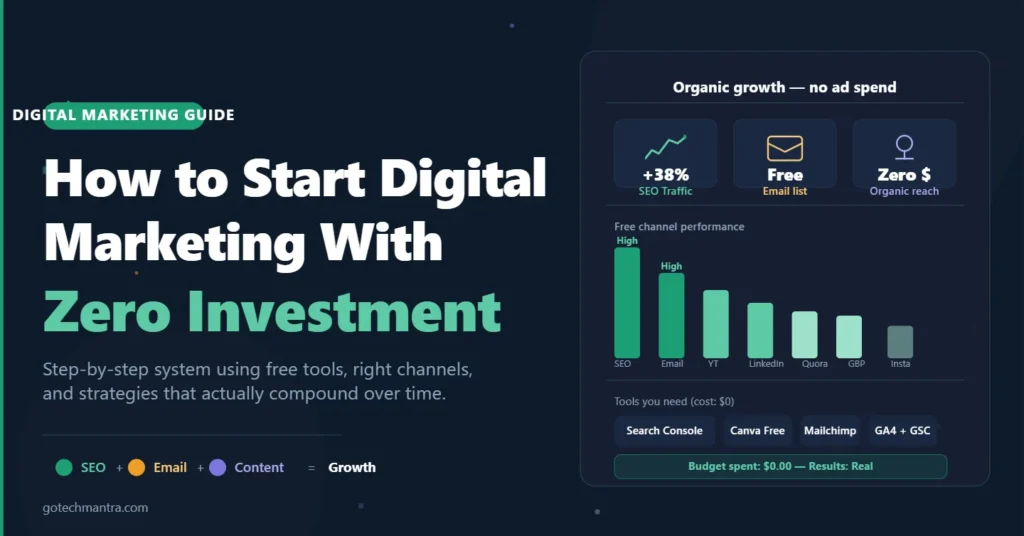
- Honestly, you don’t need a huge budget to get your brand online and actually make an impact. Google Search Console, Canva, and Brevo, for instance, are totally free and they’re genuinely powerful tools.
- Trying to tackle five different channels all at once? That’s the quickest route to disaster, trust me. One channel, handled really well, will always, always beat five channels that are just limping along.
- SEO and email are the only free strategies that compound. Social media reach is borrowed. Your blog traffic and email list? Those are yours.
What Does It Actually Mean to Start Digital Marketing With Zero Investment?
Zero investment means no cash not no effort. You’re swapping rupees for hours, and that trade only pays off if you’re strategic about it.
Folks often get “free marketing” twisted up with “easy marketing,” but honestly, they’re completely different animals. Just because a tool doesn’t cost money doesn’t mean you don’t have to put in the time to actually learn how to use it. Free platforms still reward people who show up consistently. The zero in zero investment refers to your wallet, not your workload.
What makes this worth doing, though, is that free strategies like SEO and content marketing don’t expire the way paid ads do. You run an Instagram ad, it stops the moment you stop paying. You write a well-optimized blog post, it can pull traffic for three years without you touching it again. That’s the core reason to start here, even if you eventually add a budget later.
How to Start Digital Marketing With Zero Investment: A Step-by-Step System
Do these in order. Most people skip steps 1 and 4, then wonder why nothing’s working six months later.
- Get brutally specific about who you’re talking to. Not “small business owners” try “freelance graphic designers in Hyderabad who want their first 10 clients.” The narrower the better, especially when you have no budget to spray content at a wide audience.
- Claim your Google Business Profile right now if you run any kind of local or service business. It’s free, it shows up on Google Maps, and a well-optimized GBP with genuine reviews can and does outrank businesses spending thousands on Google Ads. This is the single highest-ROI move for any local business, and most people set it up wrong or ignore it entirely.
- Start a blog. WordPress.com, Hashnode, or even a basic self-hosted site doesn’t matter much at this stage. The main thing, honestly, is making sure your content actually answers the questions folks are tapping into Google. Forget what you personally find fascinating. You really need to write about what people are already out there searching for.
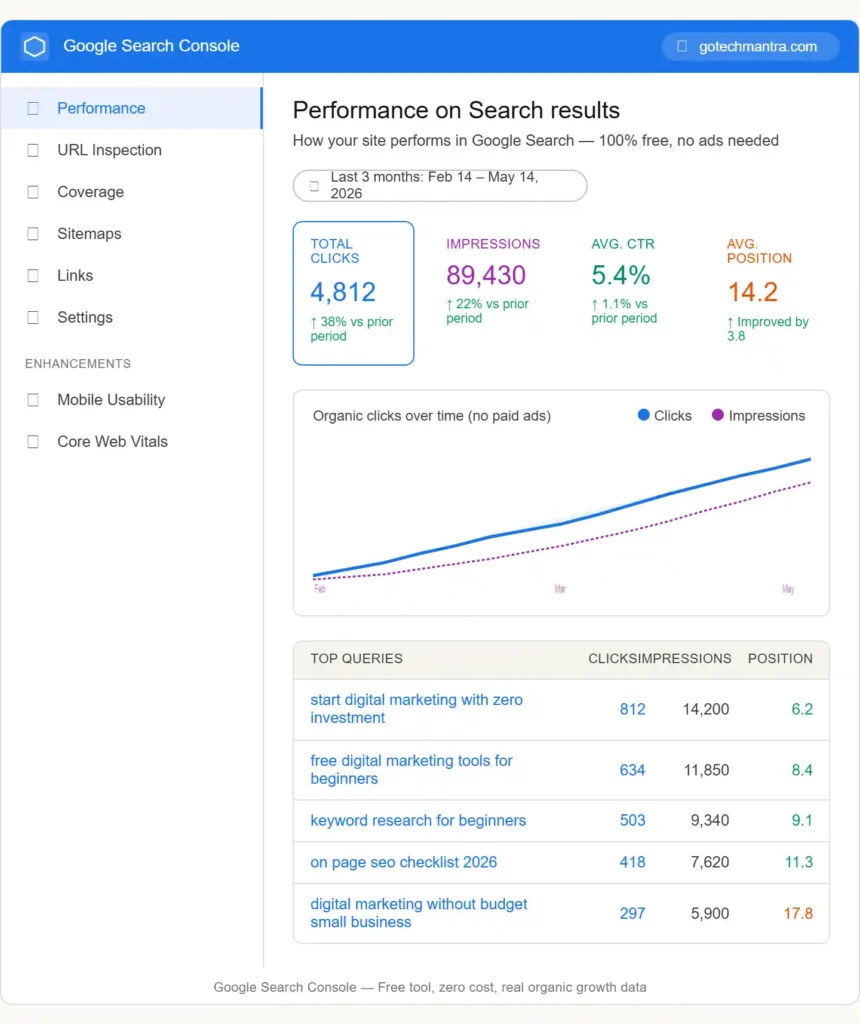
- Look, you’ve really gotta do your keyword research before cranking out any content. Honestly, this one step is the whole ballgame. It decides if your blog gets any eyeballs at all, or if it just gathers dust online for what feels like forever. Google Search Console is free. Ubersuggest has a decent free tier. AnswerThePublic gives you 3 free searches a day. Use them. And if you’re new to this, our guide on keyword research for beginners walks through the whole process without assuming you know anything going in.
- Optimize every page before you hit publish. Title tag, meta description, H2 structure, internal links none of this is optional when you have no budget to make up for weak SEO. Our on-page SEO checklist is a repeatable system you can run through in under 20 minutes per post.
- Pick one social channel. Just one. Where does your actual audience hang out? LinkedIn if you’re B2B. Instagram Reels or YouTube Shorts if your product is visual. Twitter/X if you’re in tech, finance, or anything where opinion-driven content spreads. Repurpose your blog content for that channel don’t try to create original content for six platforms simultaneously.
- Start building an email list from day one. Mailchimp is free up to 500 contacts. Brevo is free up to 300 emails per day. It doesn’t matter which one you pick what matters is that you start capturing emails before you think you need to. Social platforms change their algorithms. Google updates its rankings. Your email list doesn’t move unless you move it.
- Honestly, finding where your audience hangs out is a big one. Think about it: Reddit threads, Quora questions, Facebook Groups, LinkedIn communities they’re all jam-packed with folks who want answers to the very questions you’re good at tackling. It’s wild. I’ve seen a single, well-thought-out Quora answer in a low-competition niche pull in over 100,000 views for a small blog, sometimes ages after it was first posted. That’s not me making stuff up; it actually happens pretty consistently.
- Set up Google Analytics 4 and Google Search Console on day one. Both free. GA4 shows you what people do on your site. GSC shows you what search queries are sending them there. Without these two, you’re operating completely blind and making decisions based on gut feeling instead of data.
- Honestly, it’s pretty simple: every thirty days, you gotta check your numbers and make some real decisions. You know, double down on whatever’s actually growing, cut loose anything that’s just sitting there flat, and then here’s the kicker try one totally new thing. That’s really all there is to it. The companies that manage to win big without any budget are precisely the ones that actually iterate based on solid data, instead of constantly running after whatever the next hot, shiny tactic happens to be.
Which Free Digital Marketing Channels Actually Work?
Short answer: Honestly, SEO and email? They’re really more about playing the long game. You gotta be patient with those. Social media, though, that’s where you get much quicker feedback, but man, the reach on that stuff just disappears in a flash.
Here’s a straight comparison so you can decide where your time is worth spending:
| Channel | Time to First Results | Compounding Effect | Content Format | Best For |
| SEO / Blog | 3 to 6 months | Very High | Articles, guides | Long-term traffic |
| YouTube | 2 to 4 months | High | Video | Visual niches |
| LinkedIn Organic | 2 to 6 weeks | Medium | Posts, articles | B2B, professional services |
| Instagram Organic | 4 to 8 weeks | Low to Medium | Reels, carousels | Visual products, lifestyle |
| Quora / Reddit | 1 to 4 weeks | Medium | Text answers | Problem-awareness stage |
| Email (free tier) | Immediate | High | Newsletters | Nurturing, retention |
| Google Business Profile | 2 to 6 weeks | Medium | Reviews, posts | Local businesses |
The uncomfortable truth: most people pick Instagram because it feels fast, but SEO is the only channel where effort from month 3 still pays you in month 18.
Is Zero-Investment Digital Marketing Actually Sustainable for Small Businesses?
Yes but with one condition. You have to treat your time with the same seriousness you’d treat a cash budget. Free tools are not low-stakes. Wasting six months on the wrong channel costs you the same six months you could have spent building something that compounds.
You know, Pat Flynn’s Smart Passive Income is probably the go-to example everyone throws around for doing digital growth on a shoestring budget. And honestly, they trot it out so much because it actually teaches you something. The guy built this massive, six-figure email list all through just blogging and SEO. He didn’t even touch a paid ad until way later. It’s pretty impressive. By the time he added budget, he already had proof of what worked. He wasn’t using ads to find an audience he was using them to scale one he already owned.
That same logic applies at the local level. A home services business in Hyderabad that optimizes its Google Business Profile properly, responds to every review, posts weekly photos, and keeps its NAP consistent across directories can absolutely outrank competitors running Google Ads. I’ve watched it happen. Organic local SEO is underused because it takes patience, and most businesses don’t have patience.
Now for the part other guides skip: zero investment isn’t a forever strategy. It’s a starting strategy. There’s a point maybe around month 6 or 9 where your time becomes worth more than the cost of a premium tool or a small ad budget. When you hit that point, reinvest what you’ve earned. Zero investment gets you to validation. What comes after that is up to you.
According to the Content Marketing Institute’s B2C Content Marketing report, 80% of top-performing content marketers relied on organic content as their primary channel before they layered in paid promotion. The order matters. Organic first, paid to amplify not the other way around.
What Free Tools Do You Actually Need to Start Digital Marketing With Zero Investment?
Fewer than you think. The “101 free tools for digital marketing” lists you’ll find everywhere are mostly padding. Here’s what you actually need, organized by what stage you’re at:
| Stage | Tool | What It Does | Cost |
| Research | Google Search Console | Shows search queries, clicks, ranking positions | Free |
| Research | AnswerThePublic | Pulls real questions people type into Google | Free (3/day) |
| Content Writing | Google Docs | Writing, editing, sharing drafts | Free |
| Design | Canva Free | Social graphics, blog thumbnails, infographics | Free |
| On-Page SEO | Rank Math or Yoast (free version) | Optimizes posts before publishing | Free |
| Email Marketing | Brevo or Mailchimp | List building, newsletters, automation basics | Free tier |
| Analytics | Google Analytics 4 | Traffic, behavior, conversions | Free |
| Social Scheduling | Buffer (free for 3 channels) | Schedules posts across platforms | Free |
You don’t need to upgrade a single one of these until you’re generating consistent revenue and when you do, the revenue itself tells you which upgrade is worth paying for first.
The One Mistake That Kills Zero-Budget Digital Marketing Before It Starts
Being everywhere. Seriously, this kills more zero-budget efforts than anything else combined.
When you have no money, every hour you spend matters more than it would if you could just throw ad spend at weak content. Spreading thin across LinkedIn, Instagram, YouTube, a podcast, a newsletter, and a blog simultaneously means none of those channels gets enough consistent effort to gain traction. You end up with six mediocre presences instead of one strong one.
The rule that works: one content format, one distribution channel, 90 days minimum. Write blog posts, distribute them on LinkedIn. Make YouTube videos, cut them into Instagram Reels. Answer Quora questions, link back to your blog. One plus one. That’s the whole playbook for the first quarter.
After 90 days, look at what moved. If something’s growing, put more into it. If nothing moved, the issue is almost always either keyword targeting (you’re writing about things nobody’s searching for) or content depth (you’re giving surface-level answers to questions that deserve real detail). Fix those before you blame the channel.
Patience isn’t a soft skill here. It’s a competitive advantage. Most businesses quit between months 2 and 4, right before things start compounding. The ones who stay past that window win by default more often than they win by brilliance.
Final Word
Starting digital marketing with zero investment is genuinely doable and not in a motivational-poster kind of way. In a “here are the exact tools and steps, go execute” kind of way.
The businesses that pull this off aren’t smarter. They’re more deliberate. They pick one channel, publish consistently, track what happens, and adjust. That’s the whole game at the zero-budget stage.
Your time is the budget. Spend it on SEO and email first. Build the audience before you build the ads. And when the revenue comes, reinvest it into the channel that’s already working don’t start over somewhere new.
The tools cost nothing. The strategy is proven. Execution is the only variable left.