
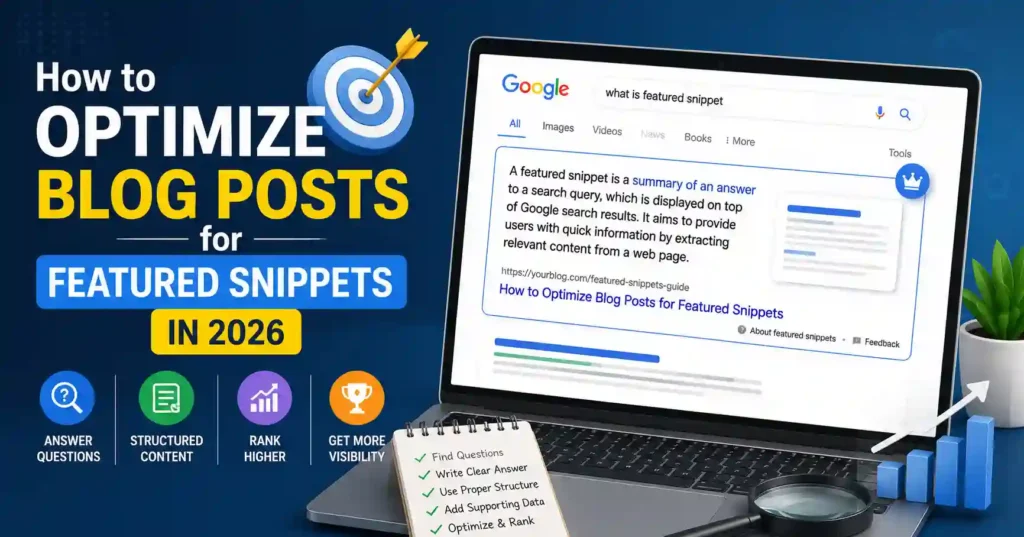

A lot of SEOs still talk about featured snippets like they are a universal growth hack. They are not. Ahrefs found that featured snippet visibility in its sample of 1,000,000 US desktop SERPs fell from 15.41 percent in January 2025 to 5.53 percent in June 2025 as AI Overviews expanded, while Semrush still reported featured snippets in about 4.5 percent of top 20 desktop results in 2024. That sounds like bad news, but for practitioners it sharpens the strategy. You do not need more snippet targets. You need better ones. Key Takeaway
- Featured snippets still matter, but now they work best as extractable answer opportunities, not vanity wins.
- The fastest way to optimize blog posts for snippets is to start with pages already ranking on page one for question-led queries and match the format Google is already rewarding.
- Structure beats length. Give the direct answer first, then add proof, examples, and the reason to click.
Why should you optimize blog posts for featured snippets now
You should optimize blog posts for featured snippets because they still win visibility on high-intent questions and the same extractable structure helps across related questions and AI-driven results. Google says featured snippets can also appear inside related questions groups, and Semrush found AI Overviews continued to skew toward informational searches through 2025.
That changes the real job. In 2026, snippet work is less about chasing a trophy box at the top of the results and more about training your page to present a clean answer that search systems can lift confidently. If the page can answer with precision, it has a better shot at showing up across more than one search surface.
For small businesses, this matters even more. You usually do not win by targeting the broadest definition query in the market. You win by answering the narrower question a buyer asks right before comparing options, asking for a quote, or shortlisting vendors. A snippet for what is CRM is interesting. A snippet for CRM vs spreadsheet for a five person team is revenue-adjacent. The angle many guides miss is that not every snippet is worth the effort. Some simple definitions create visibility but very little site engagement. The better targets are the questions that need a short answer first and deeper context second. The smartest snippet targets are not the biggest questions. They are the questions closest to a decision.
How do you optimize blog posts for snippets that search engines can extract
You cannot tag your way into a featured snippet. Google’s documentation says you cannot mark a page as a featured snippet and that its systems decide whether a page is a good match for the user’s query. That means when you optimize blog posts for featured snippets, the work is editorial and structural. Keep Google’s featured snippets documentation open while you edit, because the constraint is simple. Make the answer easier to extract than the current winner. Use this process.
- Start with question-led queries where your page already ranks on page one and a featured snippet already exists. In practice, pages sitting just below the winner are the easiest pool to work from. Chris Haines at Ahrefs recommends filtering featured snippet opportunities where you rank in positions 2 to 5.
- Inspect the live SERP before you rewrite. If Google is showing a paragraph, do not answer with a buried table. If it is showing a list, do not force a definition block.
- Place one direct answer block immediately under the most relevant H2. For paragraph snippets, think in two or three plain sentences. For process queries, use numbered steps. For comparison queries, use a real HTML table.
- Put the answer before the essay. The supporting detail can come after. This is where most blog posts fail. They warm up for six paragraphs and reach the answer too late.
- Rewrite headings to sound like the searcher’s question, not a clever editorial label. Search systems extract clarity better than creativity.
- Strengthen the page around the answer block with examples, source support, internal links, and updated context so the click still has value. If the page basics are still inconsistent, fix them with the on page SEO checklist before you chase snippets. If your opportunity list is weak, expand it with the keyword research for beginners guide and shortlist the question variants already showing answer boxes. If the answer is hard to extract, the snippet is hard to win.
What format helps you optimize blog posts for paragraph, list, and table snippets
The right format is usually the one Google already prefers for that query. Ahrefs breaks featured snippets into paragraph, list, table, and video types, and most blog-level wins come from matching the existing format more cleanly than the page currently owning it.
| Query pattern | Best snippet format | Best page element | Common mistake |
| What is X | Paragraph | H2 followed by a two or three sentence definition | Opening with brand story instead of answer |
| How to do X | Ordered list | Numbered steps directly below the heading | Hiding steps inside long paragraphs |
| X vs Y | Table | Simple comparison table in HTML | Using a screenshot image instead of a crawlable table |
| Best X for Y | Bulleted list | Short list with selection criteria | Writing a giant intro before the list |
| Cost of X | Table or paragraph | Clear range plus assumptions | Making the price impossible to find |
| Benefits of X | Bulleted list | Concise list backed by proof or examples | Generic claims with no evidence |
Can you optimize blog posts with schema alone
No. Structured data can help search systems understand your page and qualify it for some rich results, but Google says structured data does not guarantee appearance in search features, and Google’s featured snippets documentation is clear that you cannot mark a page as a featured snippet.
This is the counterargument a lot of practitioners need to hear. Schema is useful, but it is not the shortcut people wish it were. Google’s structured data guidelines say the markup must reflect visible page content, and its Article documentation recommends adding the applicable properties, validating the code, and testing pages with the Rich Results Test and URL Inspection.
You should absolutely use supported markup where it fits. Article, Product, Review, Organization, and other valid types can improve understanding and search appearance. Google also shares case studies where structured data improved click-through rate or visits for sites such as Rotten Tomatoes and Food Network. That said, those are rich result gains, not proof that schema wins featured snippets on its own.
There is another reason to stay disciplined here. Google changed the value of some old schema plays. Its 2023 update says FAQ rich results are now largely limited to well-known health and government websites, and How-To rich results are only shown for desktop users. That makes blind FAQ expansion a poor use of time for most business blogs.
For small teams, the better split is simple. Use accurate schema to support understanding, then spend the serious editing time on answer blocks, comparisons, examples, and proof. Schema is a support system. It is not the shortcut.
How should you measure whether you optimize blog posts successfully
Measure at the page and query level, not just with third-party rank flags. exposes clicks, impressions, CTR, and average position in its performance reports, which is the minimum dataset you need for before and after testing on rewritten posts.
The most effective approach would be to compare what click-throughs data looked like over 28 days before and after the update, filter by target page, and review the question-led queries related to that page.
If impressions had risen but CTR had fallen, the snippet may be driving visibility, but enough curiosity to encourage someone to click is still lacking. If impressions have increased and CTR has risen, it would appear that the relevance and user engagement have both been bolstered.
A suitable example is from Ahrefs. Chris Haines claimed that roughly 37 percent of his Ahrefs posts got featured snippets over a year.
The way to do this is outlined in the process itself: they were discovered by keywords hitherto ranking toward the top that fitted the snippet-rich format and monitoring wins/losses over time.
Google Search Console Performance report filtered to one blog post and a set of question-based queries, showing clicks, impressions, CTR, and average position before and after the featured snippet rewrite. That screenshot belongs here because it proves the right thing. It shows whether the rewrite changed search behavior, not just whether a tool temporarily labeled the keyword as a snippet win. If you cannot measure the rewrite at query level, you do not really know whether the snippet work paid off.
Final thoughts on how to optimize blog posts for featured snippets
If you want to optimize blog posts for featured snippets in 2026, stop thinking like a writer polishing intros and start thinking like an extraction editor. The page that wins is usually the page that answers first, formats correctly, proves the answer, and gives the reader a reason to keep going. The counterpoint is real. Some snippets will reduce clicks on shallow queries. That is why the goal is not to optimize every blog post for every snippet.
The goal is to optimize the right blog posts for the right questions, especially the ones that sit just before comparison, evaluation, or action. The blogs that win snippets are not always the biggest. They are the easiest for search systems to understand and the most useful for real people.