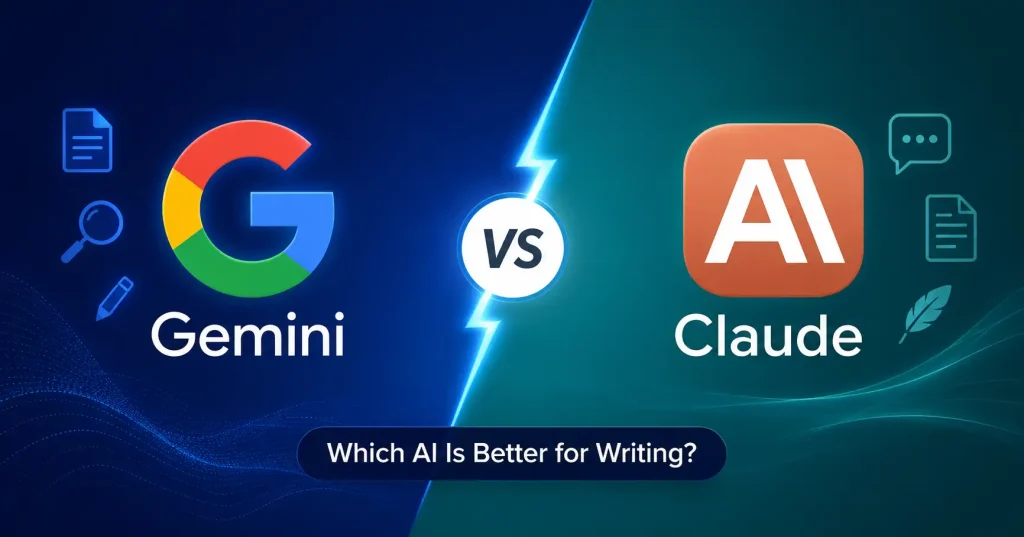

When people ask about Gemini versus Claude for writing, they often want a quick winner. But it is not that neat. Both tools can draft blog posts, rework text, pull out key points from a document, and generate new ideas. They can also help you polish what you already wrote. What changes is the way each one guides you through the task.
Gemini tends to feel easier if you are already working in Google apps and services. Its Canvas workspace lets you create and refine documents, adjust tone and length, and work with files while building content.
Claude, meanwhile, has built a strong reputation around long form writing, careful editing, structured thinking, and working with substantial amounts of context.
So, which one should writers actually use? It depends on whether you care more about research and productivity integration, or the feel and refinement of the finished prose.
Gemini vs Claude: Which One Is Better for Writing?
For most serious writing work, Claude gets the slight edge for pure writing and editing, while Gemini can be the more convenient choice for research heavy workflows and writers already using Google products.
That doesn’t mean Claude automatically produces better articles. A weak prompt can produce weak writing in either tool. Drop identical notes and tone rules into both models, then watch. The stark difference pops right out at you.
Think of it this way: Gemini often feels like a broader productivity assistant that happens to be very capable at writing. Claude feels more focused on the actual craft of working with text.
Claude for Writing: Where It Stands Out
Claude is particularly comfortable with long form content. Give it a detailed brief, a collection of notes, a style guide, and several sections that need rewriting, and it can work through the material without constantly forcing you back into a short prompt and response workflow.
Its Projects feature can also keep related conversations, documents, instructions, and knowledge together, which is useful for ongoing content projects. Claude’s Artifacts workspace provides another way to create and refine documents alongside the conversation.
For example, imagine you’re preparing a 2,000 word SaaS article. You could provide the target audience, product positioning, competitor notes, keyword requirements, tone guidelines, and an existing draft. Claude can then help restructure the article, tighten repetitive sections, and rewrite individual passages while preserving the broader argument.
That’s where Claude tends to feel especially useful: editing something that already exists rather than simply generating another generic first draft.
Claude is a strong choice for:
- Long form blog posts and articles
- Rewriting and polishing existing drafts
- Brand voice development
- Detailed explanations
- Turning rough notes into structured content
- Working with large amounts of reference material
It’s also worth checking Anthropic’s current product information before choosing a paid Claude plan because features and model availability can change.
Gemini for Writing: Where It Stands Out
Gemini takes a slightly different route. Its writing capabilities become especially useful when they’re connected to research, files, Google Workspace, and the broader Google ecosystem.
Gemini’s Canvas provides a dedicated workspace for creating and editing documents. You can select text, ask for changes, adjust the length or tone, and continue refining the document instead of repeatedly copying text between a chatbot and a word processor.
That’s handy for students, marketers, content teams, and professionals who already live in Google Docs and related services.
Suppose you’re writing a product comparison and have research notes, documents, and supporting material ready. Gemini can be useful when the writing task is part of a larger research and document workflow rather than an isolated copywriting job.
Google has also continued expanding Gemini’s research and Canvas capabilities, including tools for creating and refining documents from research material.
Gemini is a strong choice for:
- Research assisted writing
- Drafting and editing documents
- Google Workspace users
- Brainstorming content ideas
- Turning research into structured material
- Writers who want writing and productivity tools in one ecosystem
Gemini vs Claude for Blog Writing
For bloggers, the choice gets more interesting.
If you want natural long form writing, try Claude first. It usually helps when you already know the main point. Then it can help you make the piece clearer. It can also help you arrange it better and cut down on repeats.
Gemini is attractive when research is a major part of your workflow. You might use it to explore a topic, organize information, create an initial structure, and then develop the article inside Canvas.
Neither should be treated as an automatic publishing machine. AI can write with good grammar, but it can still miss the point. Sometimes the examples stay thin, the claims feel off, and the reader gets little from it.
If you publish for search engines, a better setup is to use AI to speed things up. Keep the key editorial choices in human hands. Your Best AI Tools for Digital Marketing guide covers how AI can fit into a broader content and marketing workflow.
Gemini vs Claude for Editing
This is where the difference becomes noticeable.
Need an editor, not just fresh content? Claude’s your guy. Just feed it a paragraph and tell it what to do. It’ll trim the fluff, sharpen your arguments, and make it all clearer, but it won’t gut your voice.
Gemini can pull this off too. Especially in Canvas, you can highlight text and ask for specific tweaks.That makes it practical for people who prefer a visual document editing workflow.
A useful test is to take one of your existing articles and ask both tools to perform the same five jobs:
- Remove unnecessary repetition.
- Make the introduction more engaging.
- Preserve the original author’s voice.
- Improve transitions between sections.
- Identify unsupported or unclear claims.
Don’t judge the tools based on the first draft alone. Compare the edits. That’s usually where you’ll discover which one fits your writing style.
Gemini vs Claude for SEO Content
Do not treat Gemini or Claude as an SEO plan on their own. A strong SEO post still has to match what people are actually looking for.
You also need helpful material, set it out in a clear order, and add links to related pages on your site.Using your own examples matters too.Claims should be checked and kept correct.AI tools can support some of this work, but they do not replace your review and decisions.
Asking one tool to “write a 1,500 word article about SaaS security” is not the full answer. A better plan sets the reader it is meant for, the main keyword, the side topics to include, which sites to compare against, why the piece is being made, what links should go inside it, the tone to match, and the exact items the article needs to cover.
If you put out AI assisted posts on a regular schedule, your overall content plan matters just as much as the tool you use.
Your Best Free AI Image Generators for Websites guide is another useful example of building supporting assets around content rather than treating text generation as the entire workflow.
Which Is Better for Different Types of Writers?
The easiest way to decide is to match the tool to the job.
Choose Claude if you: I write long pieces and I also do a lot of edits. I try to get the tone right and make the reading feel smooth. I often handle big reference files too.
Choose Gemini if you: You’ll likely use a lot of Google tools. You can mix research right into your writing. It also works in Canvas, so your writing flow stays tied to Google’s productivity setup.
Use both if you: produce content professionally and don’t mind testing the same brief in different tools.Relying on a single model rarely works out well. Switch things up. Let one build outlines, and another polish the messy drafts.
How to Get Better Writing From Either AI
The biggest improvement usually comes from better input, not switching models.
Give the AI enough information to make a useful decision. Include:
- Who the article is for
- What the reader already knows
- The purpose of the content
- The desired tone
- Important facts or source material
- Examples of writing you like
- Words, claims, or styles to avoid
Then work in stages. Start with the angle and outline. Develop the sections. Review the weak parts. Rewrite. Fact check. Finally, edit the finished article yourself.
That process produces much better results than asking an AI to “write a perfect article” and publishing whatever appears on screen.
FAQ’s
Is Claude better than Gemini for writing?
Claude has an advantage for writers who prioritize long form prose, editing, structure, and maintaining context. Gemini can be the better fit when writing is closely connected to research and Google productivity tools.
Is Gemini good for blog writing?
Yes, Gemini can support brainstorming, writing drafts, editing, finding information, and making documents. The Canvas view is handy when you need to work on longer pieces and revise them over time.
Which is better for SEO writing, Gemini or Claude?
Neither automatically produces better SEO content. The quality depends heavily on the brief, research, search intent, editing, and fact checking. Claude may suit writers focused on prose and editing, while Gemini can be useful for research driven workflows.
Can Claude and Gemini write in a specific brand voice?
Yes. Both can follow detailed style instructions. The more useful approach is to provide actual examples of your brand’s writing and explain what should be preserved rather than simply asking for a “professional tone.”
Should I use AI generated articles without editing them?
Even a solid AI draft can still be wrong in spots. It may also include parts that feel too general, repeat itself, or use examples that do not land. That is why human review should stay in the publishing workflow.
Can I use Gemini and Claude together?
Assign one tool to gather research or sketch outlines, letting another handle the draft. The real secret is simple: divide the labor entirely. Stop forcing both systems to endlessly churn out identical rewrites.
Conclusion
Claude wins for long form drafting, structure, and polished prose. That is your starting point if writing matters most. Gemini takes the practical crown instead. Why? Research, document editing, and Google ecosystem integration all live right there.
The smartest approach is to test both on your actual workload. Give them the same article brief, the same reference material, and the same editing task. Then judge the results based on something that matters more than benchmark scores: how much useful work remains after the AI finishes.
For professional content teams, that’s ultimately the real measure. A top AI writing helper is not the one that spits out the longest response. It is the one that lets you finish real work faster, with fewer extra steps.