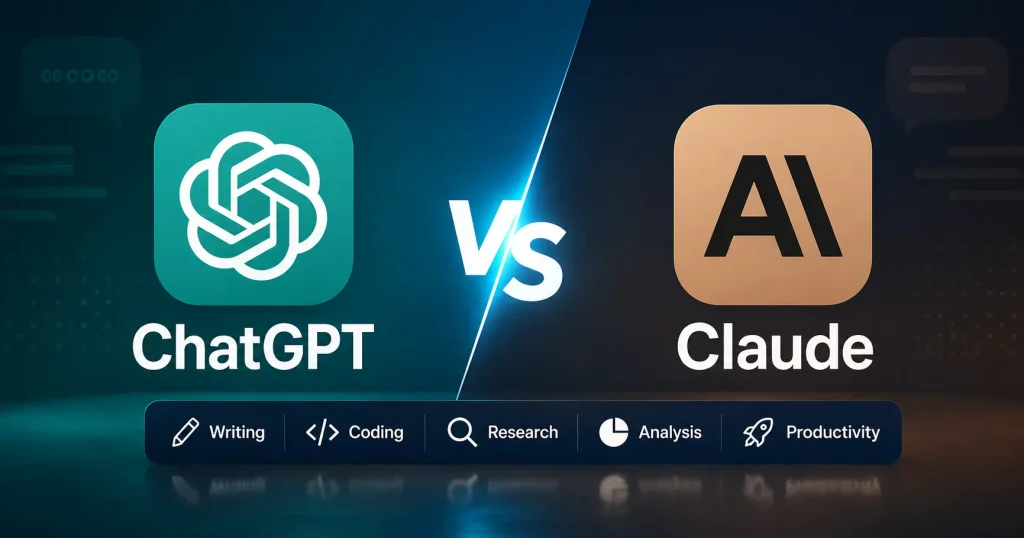

Picking between ChatGPT and Claude can feel messy, and it is not just about one being “better.” Both can help you write, summarize, clarify tough ideas, sort through information, and assist with code. They also work for daily tasks.
What you should use depends on your goals.
Some people prefer ChatGPT because it mixes chat with extra tools. It can do things like web search, work with files, create images, and help with data tasks. Claude is often seen as a steady option for writing, thinking through problems, coding, and reviewing documents. It can also handle longer work sessions with less fuss.
This guide compares the two in real life. It shows where each one tends to fit, what stands out during use, and how to pick one so you do not pay for two services you will not use much.
ChatGPT vs Claude: What’s the Difference?
Both tools can handle many kinds of work. Ask one of them a question, or share a doc, a thought, some code, or a draft. Then talk through the task step by step in chat.
The bigger difference is the surrounding experience. ChatGPT has developed into a broader AI workspace with capabilities that can include web search, file and image analysis, data analysis, image generation, projects, and other tools depending on the plan and settings.
Claude takes a similarly broad approach but puts particular emphasis on writing, reasoning, coding, research, document analysis, projects, and artifacts. ‘
Anthropic also offers Claude in a browser, on desktop, on mobile, and through tools made for developers.
Because of that, this does not feel like a clash between a smart system and a weaker one. It is better to see them as two setups for working with strong language models.
ChatGPT: Where It Makes More Sense
ChatGPT stands out when you need a single AI to juggle a bunch of different tasks. Take a marketer. They can jump from brainstorming ad campaigns to tearing apart a messy spreadsheet, pulling fresh web data, drafting copy, generating images, and polishing the final product right inside the same chat window.
That versatility is a huge selling point. The system handles files, scans images, digs up live web info, tackles coding logic. And backs up all kinds of creative and productivity chores.
Best use cases for ChatGPT
ChatGPT is particularly useful for:
- General research and question answering
- Blog outlines, editing and content development
- Brainstorming and ideation
- Data and spreadsheet analysis
- Coding assistance
- Working with uploaded documents and images
- Current information research through web search
- Creating and refining visual content
Say you are lining up a SaaS product comparison. You might use ChatGPT to sort your notes, spot missing parts in your plan, review a sheet of product details, and rewrite the draft for the people you want to reach. Being able to shift between tasks like that can matter more than getting the top result in just one area.
If you take on more than one kind of freelance job, the guide on Best AI Tools for Freelancers can help you set up a wider AI routine. Use it alongside your main helper.
Claude: Where It Makes More Sense
Claude is especially appealing when the work revolves around substantial amounts of text, detailed reasoning, coding, or careful writing. Anthropic positions Claude for tasks including writing, research, analysis, coding, document review, data analysis, and interactive artifacts.
The writing experience is one reason many users keep Claude in their toolkit.Feed it a messy brief, some raw notes, or a tangled document. Ask it to clean up the contradictions, reorganize the flow, or sharpen the prose. The core message, Untouched.
Best use cases for Claude
Claude can be a good fit for:
- Long form writing and editing
- Reviewing lengthy documents
- Coding and code analysis
- Detailed reasoning
- Research and synthesis
- Working with project specific context
- Creating artifacts and interactive outputs
- Turning rough material into structured documents
Consider a developer reviewing a large codebase. They could share code they already have and ask Claude to study how it is set up. Then they might want it to spot an issue, propose a simpler way to write it, and walk through what would change. This back and forth can help more than starting with fresh code.
Claude also has Projects to keep related chats and notes in one place. Its artifacts can turn ideas into things people can share, like documents, charts, and code, plus other interactive items.
ChatGPT vs Claude for Writing
There is no single best choice for daily writing. One tool can handle emails, blog drafts, posts for social media, summaries, reports, and similar tasks.
If writing is only one step in a bigger job, ChatGPT is often the easier fit. You can go from gathering notes to drafting text to doing analysis to making visuals, all in the same place.
If the main work is the words themselves, Claude can feel better. It helps with getting the right tone, fixing long sections, checking drafts, and working through detailed notes and sources.
A simple trial beats a long list of claims. Use the same short brief for a real article. Use the same source notes. Set the same style rules. Then check the draft you get and also how much you still have to edit.The tool that saves you more cleanup time wins.
ChatGPT vs Claude for Coding
They both handle writing, explaining, debugging, and refactoring. Which tool wins, Honestly, that depends entirely on your language, codebase scale, environment, and specific goals. Even so, Claude really stands out when you drop it right into standard developer workflows.
Anthropic’s current Claude offering includes coding assistance, code analysis, and developer tools, while its more advanced models are designed for demanding coding and agent tasks.
ChatGPT is useful when coding is mixed with other work.Say a dev needs help fixing a bug, digging through a dataset, pulling fresh docs, whipping up a chart, or drafting code. Benchmarks alone won’t tell you if the model is actually ready for heavy development work. Don’t trust the score sheets blindly.
Put each one against a real task from your own codebase. That’s where differences in context handling, debugging style, instruction following, and tool support become obvious.
ChatGPT vs Claude for Research
Research is another area where both platforms have become much more capable. ChatGPT can search the web and provide source backed responses when current information is needed.
Claude can also search the web and supports research workflows that combine external information with documents and connected sources.
The deciding factor should be your research workflow. If you frequently need current web information alongside data analysis, files, and other tools, ChatGPT may fit naturally. Got a ton of documents to sift through? Need to turn all that into some kind of structured analysis? Claude’s worth a shot.
But here’s the thing: don’t ever take an AI’s answer as gospel, Always pull up those key references. Double check its claims. Make sure the dates line up. An AI can spin a pretty lie as easily as it can nail a useful summary.
Which AI Is Better for Everyday Use?
ChatGPT usually wins as the default pick for casual users. It just handles a wider stack of random jobs in one single window. Plan a vacation, study some history, bang out an email, tear through a spreadsheet, or chase down breaking news. Naturally, the exact quality depends heavily on your subscription tier.
Claude holds its own as a daily driver too. Particularly if your desk is buried in code, dense documents, or long form writing where nuance truly matters. For heavy text work, its streamlined approach might suit you better.
How to Choose Between ChatGPT and Claude
Don’t choose based on whichever AI happens to be trending this week. Start with your actual workload.
- List your five most common AI tasks. Think about what you actually use an assistant for right now. Not what you plan to use it for later.
- Identify your biggest bottleneck.Is this about research, or is it writing, coding, and document review? Maybe it is data analysis, or something different.
- Test both on the same tasks. Use identical prompts and source material where possible.
- Measure editing time. A slightly better first answer isn’t useful if it takes longer to turn into a finished result.
- Check the tools around the model. Web search, file handling, integrations, projects, artifacts, image capabilities, and other features can matter as much as the underlying model.
- Consider your budget. Start with free access where available and upgrade only when a paid capability solves a problem you regularly have.
One useful approach is to keep both available during the testing stage. After a few weeks, you’ll probably notice that one becomes your default while the other gets used for specific jobs.
ChatGPT vs Claude: Which One Should You Use?
Pick ChatGPT if you need an AI helper that can switch between tasks like research, writing, working with data, handling files, working with images, and coding. You should not have to use a different app for each small job.
Pick Claude if your day is mostly long text work. That can mean reading and breaking down documents, doing coding help, doing deeper reasoning, or managing a project where everything is connected.
If you are a freelancer, a marketer, a writer, a student, or just someone trying this out, ChatGPT is a good first choice. For developers, researchers, writers handling substantial documents, and people who prefer Claude’s writing and project workflow, Claude deserves a serious trial.
There’s also nothing wrong with using both. A writer might brainstorm and research in ChatGPT, then use Claude to critique a long draft. A developer might use Claude for code heavy work and ChatGPT when the same project requires research, data analysis, or another tool.
If you’re building an AI heavy content workflow, you may also want to compare these assistants with the tools in our guide to Best AI Tools for YouTube Content Creation .
FAQ’s
Is ChatGPT better than Claude?
Not across every task. ChatGPT is a strong general purpose choice with a broad collection of tools, while Claude can be particularly useful for writing, document analysis, coding, and detailed reasoning. Your workload should determine the better option.
Is Claude better for writing than ChatGPT?
Claude can be an excellent choice for long form writing, editing, and working with detailed source material. ChatGPT can write well. It is even more helpful when writing goes along with research and data work. It can also be useful when you add images or other related tasks.
Which is better for coding, ChatGPT or Claude?
Both can write and debug code. Claude is worth testing for code heavy and larger development projects, while ChatGPT can be a better fit when coding is part of a broader workflow involving research, files, data, or other tools.
Can ChatGPT and Claude analyze documents?
Both manage files, extract data, distill details, and explore deeply, yet limits and features vary by plan. Honestly, verify their current capabilities before committing your entire workflow to either tool.
Should I pay for both ChatGPT and Claude?
Usually not at first. Test the free tiers first. Pit them directly against your daily workload. Seriously. Then, subscribe only to the one that actually buys back enough hours to earn its keep. Or maybe keep both if they handle completely separate tasks.
Which AI should a beginner use?
ChatGPT is a sensible starting point for beginners who want one tool for many different tasks. Claude is worth trying too, particularly if writing, document analysis, or coding makes up most of your workload.
Conclusion
The real answer to ChatGPT versus Claude is simple. Neither wins forever. Both handle themselves well enough that the choice usually depends heavily on your daily tasks, your specific workflow. And whatever else plugs directly into the model.
ChatGPT thrives as a broad, bustling AI workspace, handling everyday questions, background research, raw data, file uploads, and images without breaking a sweat. Claude truly stands out when jobs get heavy on deep writing, dense documents, complex coding, and tricky multi step reasoning.
The smartest way to decide is just to test them both on the exact tasks you face every day, compare the final output, see how much editing you have to do, and figure out which tool actually fits your rhythm. The AI that consistently helps you finish real work faster is the one worth keeping.
For a deeper look at how AI fits into different professional workflows, you can also explore our other practical AI guides on GoTechMantra.