
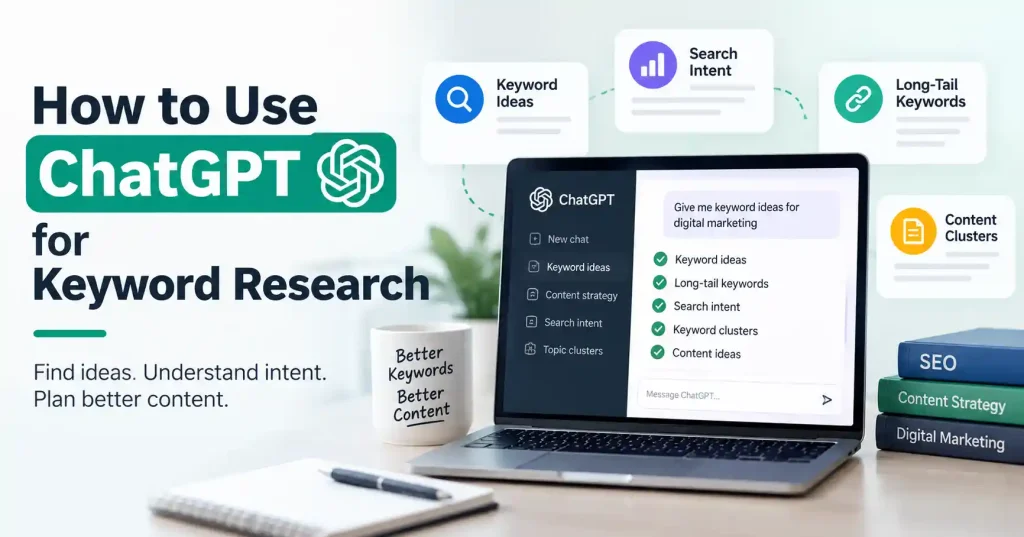

You do not have to begin keyword research by opening a spreadsheet with search volume and competition numbers. ChatGPT can help you take a wide topic and turn it into keyword ideas. It can also suggest related searches, sort terms by intent, and help you map out what to write next. The main part is how you prompt it. You also need to know what not to believe without verifying.
If you are figuring out how to use ChatGPT for keyword research, treat it like a helper, not a full SEO tool. It can list and organize ideas fast. Still, you should confirm things like search volume, keyword difficulty, ranking difficulty, and what shows up in the real SERP. Use solid SEO data for that.
What Can ChatGPT Do for Keyword Research?
ChatGPT really shines during the messy, early stages of keyword research, Just feed it a topic, an audience, your product, or a specific problem. Then ask it to brainstorm how real people actually search for that subject.
Picture a SaaS company selling project management software. Skip the lazy prompt asking for basic keywords. Instead, make ChatGPT dig deep into the actual, nagging headaches your customers face before buying a tool, while actively using it, and even long after.
That can produce keyword directions such as:
- project management software for small teams
- best project management tools for remote teams
- how to manage projects remotely
- project management software comparison
- free project management software
- project management templates for beginners
The value isn’t just the list. The bigger benefit is seeing the topic from different searcher perspectives.
How to Use ChatGPT for Keyword Research Step by Step
1. Start with a clear topic and audience
Your initial prompt must supply ChatGPT with ample context, Vague instructions yield generic lists. Try this instead, Act as an SEO strategist. I run a SaaS website that sells project management software for small businesses. Generate keyword ideas based on the problems, questions, comparisons, and buying decisions of my target audience. You can sharpen the output easily. Toss in the target country, the exact industry, who your buyer is, your product category. And where they sit in the funnel. It works.
2. Ask for keyword variations
Once you have a starting list, ask ChatGPT to expand it. This is where it can save a lot of manual brainstorming.
Try asking for:
- Long tail keyword variations
- Question based searches
- Comparison keywords
- Commercial intent keywords
- Informational keywords
- Problem based searches
- Beginner friendly searches
- Alternative phrases and synonyms
Two searches can look similar but mean different things. If someone types “how to organize team tasks,” they may want steps or a simple method. If they type “best task management software for teams,” they may want tools and comparisons. Even though both topics fit under one general area, the user should not be sent to the same result every time.
3. Use ChatGPT to identify search intent
Keyword research gets better once you know the reason behind the search.
Share a list of keywords with ChatGPT. Then tell it to label each one as one of these: informational, commercial investigation, transactional, or navigational. You can also request a quick page type for each keyword.
For instance, “best CRM for startups” sounds like a side by side comparison. A roundup of top choices could match. “How does a CRM work?” points to a guide or explainer. “CRM pricing” often means the person may be nearing a purchase.
Doing this can help you avoid a common SEO slip. You might write for the keyword, but miss the real intent of the searcher.
4. Ask ChatGPT for long tail keywords
Long tail keywords are easier to turn into focused content. Why? They are just more specific. ChatGPT helps dig up these niche angles starting from a wide topic.
Take email marketing. Instead of leaving it there, prompt the tool directly: generate 30 specific long tail keyword ideas around email marketing for small businesses. Focus on problems, use cases, beginner questions, software comparisons, and implementation.
Then sift through the output yourself. Certain suggestions work brilliantly. Others sound completely made up, things nobody types into a search bar.
That is just how it goes. ChatGPT expands a concept well, but it has no idea if anyone actually searches for those exact phrases.
5. Build keyword clusters
A long keyword list isn’t particularly useful if every term becomes a separate article. ChatGPT can help you organize related keywords into clusters around a main topic.
For example:
Main topic: Email marketing for small businesses
Cluster: Getting started
- email marketing for beginners
- how to start email marketing
- email marketing basics
Cluster: Strategy - email marketing strategy
- small business email marketing strategy
- email campaign ideas
Cluster: Tools - best email marketing software
- email marketing tools for small business
- free email marketing platforms
This structure can help you decide which topics deserve their own pages and which keywords can be covered naturally within one comprehensive article.
For more background on building a broader SEO process, see GoTechMantra’s keyword research guide for beginners.
Use ChatGPT to Find Content Gaps
ChatGPT can also be useful when you already have a keyword list or existing content. Give it your article outline and ask:
“What important subtopics, questions, or related concepts are missing from this outline?”
You can then compare those suggestions against the pages currently ranking for the target query.
This matters because good keyword research isn’t just about finding more phrases. It’s about understanding the subject well enough to create a page that covers the reader’s actual needs.
If you already have pages that match, ChatGPT can point out where to add internal links. For instance, a post on keyword research can link well to your beginner guide to AI SEO tools, your on page SEO page, your content strategy notes, or your blogging tips.
Useful ChatGPT Prompts for Keyword Research
Your keyword research results can swing a lot based on how you write the prompt. Instead of typing “give me keywords,” try giving ChatGPT a clear task to do.
Here are several prompts worth keeping:
Try this prompt for keyword discovery: Generate keyword ideas for topic aimed at audience. Include informational, commercial, transactional, and question based searches.
When long tail terms are the goal, try this: Create 30 long tail keyword variations for topic. Prioritize specific problems, use cases, comparisons, and beginner questions.
For search intent, ask: Classify these keywords by search intent and recommend the most suitable content type for each one. Seriously.
Clustering is actually easy with this prompt: Group these keywords into logical topic clusters, identify one primary keyword for each cluster and related secondary terms.
To find gaps, run this exact line: Review this article outline and identify missing subtopics.
If you share more background, the answer usually helps more.
Don’t Use ChatGPT as Your Keyword Database
Beginners mess this up constantly. ChatGPT hands you keyword ideas, sure. But don’t blindly trust that the generated terms carry real monthly search volume, actual difficulty scores, CPC, or ranking potential. Always double check those numbers through a reliable SEO tool first, Otherwise, you’re flying completely blind.
A better workflow is simple:
- Use ChatGPT to brainstorm and expand keyword ideas.
- Export or copy the useful suggestions into your SEO tool.
- Check search volume, competition, trends, and SERP results.
- Remove irrelevant or unrealistic phrases.
- Group the remaining keywords by intent and topic.
- Choose targets based on your site’s authority, audience, and business goals.
If you are using ChatGPT for research, its web search can help you find recent details and point you to sources. Still, you should check what it gives you. Do not treat the results as correct right away. You can use ChatGPT here: ChatGPT.
How to Validate ChatGPT Keyword Ideas
After you get a keyword list from ChatGPT, validate it.
Start by checking the live search results. What shows up on the first page? You may see blog posts, product pages, category pages, comparison posts, video results, or other formats.
Next, judge whether your site can compete. Even if a keyword has strong commercial intent, it may not be a good choice when big brands dominate the results. If your site lacks topic depth, you may struggle to rank.
Also review relevance. Strong search volume does not help if the people who click are not looking for what you sell or explain.
Google’s SEO guidance says to focus on helpful content built for people. It also recommends using the terms your audience would naturally search for, instead of repeating keywords too much.
Common Mistakes When Using ChatGPT for Keyword Research
One classic trap is chasing hundreds of keywords under the faulty assumption that raw volume beats quality. It doesn’t. A tight, focused list of related terms with obvious intent makes building an actual content plan way simpler.
Then there is the habit of trusting every single machine generated phrase like it is gospel. Some ideas are just weird, hyper specific, or words real people never type into a search bar.
Keyword stuffing is another old blunder. You grabbed your targets, sure, but do not cram them into every single header and paragraph. Just write naturally. Cover the subject well and toss in relevant terms only when they actually help the reader out.
And look, don’t let a bot run your whole SEO strategy. Real customers, real competitors, and your own business goals need to steer the ship.
A Simple ChatGPT Keyword Research Workflow
If you want a repeatable process, keep it straightforward:
- Choose a broad topic connected to your business.
- Give ChatGPT details about your audience and generate keyword ideas.
- Ask for long tail variations and questions.
- Classify the keywords by search intent.
- Group related terms into topic clusters.
- Run your top concepts through an SEO platform beforehand, Scan the live SERP to grasp what format Google genuinely craves.
- Select primary and secondary terms for each page.
- Shape the article around the core problem the reader needs solved, not just some rigid keyword.
- Revisit the metrics later to refine the page once the data speaks, that is how you leverage ChatGPT properly. To think, compare, and explore.
FAQ’s
Can ChatGPT do keyword research?
ChatGPT definitely helps brainstorm keywords, expand seed terms, pin down user intent, and bundle queries into neat clusters. It flags questions well, too. Still, don’t ditch actual SERP checks or dedicated keyword databases. It cannot replace them.
Is ChatGPT good for finding long tail keywords?
Yes. It helps when you want to try different angles for a certain audience, a clear issue, a product, or a specific way of using it. Just be sure to check the ideas with real search numbers.
Can ChatGPT tell me keyword search volume?
Feed it your own search volumes and let it run the math. Don’t trust its raw guesswork, though you’d be crazy to skip checking real SEO software or your own first party metrics. Verify everything.
What should I include in a ChatGPT keyword research prompt?
Drop the topic, target audience, and location. Business type matters too, Search intent, customer pain points, and your planned content type round it out. More details mean better suggestions.
Can ChatGPT group keywords by search intent?
Got it. Informational, commercial, transactional, navigational intent. We will sort those keywords, see how they stack up, then we compare my guesses against the real deal.
Should I use ChatGPT alone for SEO keyword research?
ChatGPT’s good for ideas and sorting research. But a better way? Mix AI help with actual keyword data, SERP snooping, checking out rivals, and knowing your audience inside and out.
Conclusion
Figuring out ChatGPT for keyword research zips up the early SEO grind. Forget staring at a blank spreadsheet, you can get it to spit out ideas, flesh out topics, dig up questions people ask, figure out what they mean by a search. And then sort related searches into neat little groups.
The sweet spot? Blend that AI flexibility with actual SEO data. Let ChatGPT do the heavy lifting on brainstorming and organizing. Then, back up the big calls using keyword metrics and what’s actually ranking on Google.
Most critical part, though: don’t just grab a keyword because the AI thought of it. Pick it because it fits who you’re talking to, helps your business goals. And you’ve got a real shot at making something better than what’s already out there.