
Most small businesses do not fail at digital marketing because they lack effort. They fail because every platform looks urgent. One day, it’s Instagram Reels; the next day, an AI search. Then, the paid option: the next day something about WhatsApp automation has got to be on point, then the influencers; otherwise, paid search optimization. The real issue is not being reactive to priority.
Key Takeaway
- Small business digital marketing strategies should concentrate on owned media, repeat exposure, and conversion, instead of scaling paid ads.
- Trying to follow every trend of every platform is not going to win small businesses any time soon.
- In 2026, the name of the game will be combining SEO, genuinely useful content, local visibility, email, and smart automation.
What are the best digital marketing strategies for small business in 2026?
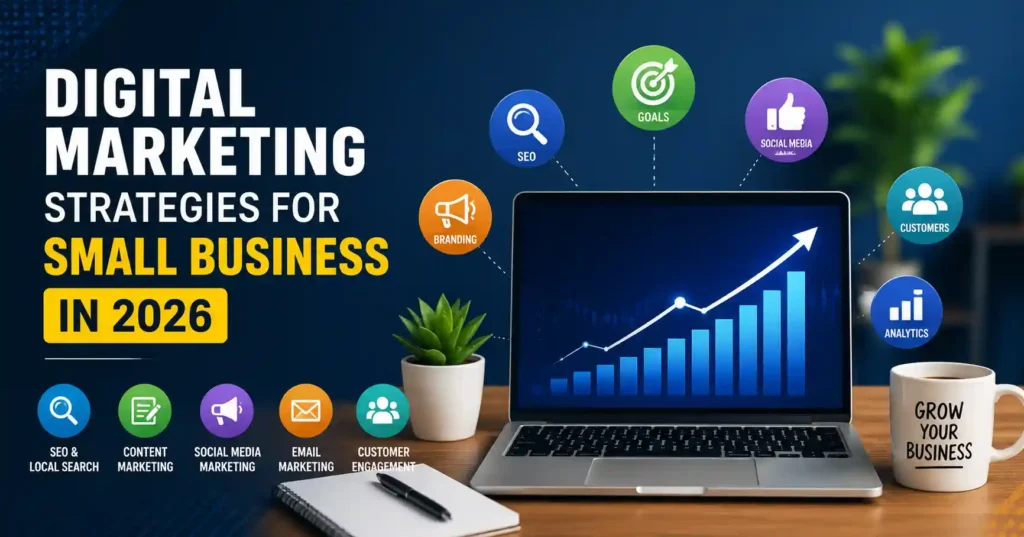
In 2026, some of the best small business digital marketing strategies would be SEO, local, content, email, social proof marketing, short-form video, and conversion optimization. Integrated, these channels work wonders–they should not be treated in isolation.
So, it’s also quite simple, a bakery must not only put up pictures of cakes on Instagram. But instead, they have to rank for the query birthday cake shop near me, collect WhatsApp leads, display some social proof reviews about the happy customers, create a few location pages, offer consumers who come to their site an opportunity to avail an offer one more time. That’s the way a system is built.
The usual mistake is thinking of marketing channels as individual tasks. The SEO guy operates independently. Social media guy operates independently. Ads guy operates independently. Nobody is managing the user journey.
Your real goal is simple. Make people discover you, trust you, contact you, and come back again.
For SEO foundations, small businesses can start with the on page SEO checklist to improve page structure, content quality, and ranking signals before spending heavily on ads.
Clear takeaway: The best strategy is not the trendiest channel. It is the channel mix that moves people from discovery to enqaury.
How should a small business build a digital marketing plan?
Informed by the dedication and practical nature of targeting the plan, a digital marketing plan would ideally focus on a primary offer, primary audience, traffic source, building of trust work, and solid conversion path for small businesses.
Here is a practical step-by-step process.
- Define the core offer
Pick the product or service that gives you the best margin and fastest sales cycle. Do not promote everything equally.
- Identify the highest-intent audience
Focus on people already searching or comparing options. They are easier to convert than cold audiences. - Choose one primary traffic channel
For local services, this may be Google Business Profile and SEO. For visual products, it may be Instagram plus search. For B2B, LinkedIn and SEO may work better. - Create one strong landing page
Your page should explain the offer, benefits, proof, pricing context, and enquiry option clearly. - Add trust signals
Use reviews, testimonials, before and after results, certifications, case studies, and real photos. - Build a follow-up system
Use email, WhatsApp, or CRM reminders so leads do not disappear after one enquiry. - Review results every month
When it comes to attracting customers, old customers, visitors to your website, email subscribers and even your WhatsApp contacts tend to convert into leads very quickly basing on relevant statistics that have been gathered.
Clear takeaway: A small business marketing plan should be narrow enough to execute and strong enough to repeat.
Which digital marketing channels work best for small businesses?
The best channel depends on your business model, buying cycle, and customer intent. Search works better when people already know the problem. Social works better when demand needs to be created.
| Channel | Best For | Main Strength | Watch Out For |
| SEO | Long-term leads | Compounding traffic | Takes time |
| Google Business Profile | Local businesses | High-intent enquiries | Needs reviews |
| Short-form video | Awareness | Fast reach | Low direct conversion |
| Email marketing | Repeat sales | Low cost retention | Needs list building |
| WhatsApp marketing | Lead nurturing | Fast response | Can feel spammy |
| Paid ads | Quick testing | Immediate visibility | Cost rises fast |
| Content marketing | Trust building | Supports SEO and sales | Needs consistency |
Google also recommends creating helpful, reliable, people-first content and making your website easy for search engines and users to understand through itsSEO Starter Guide.
Clear takeaway: Pick channels based on buyer intent, not platform popularity.
How can small businesses use SEO and content without wasting time?
Small businesses should use SEO to target practical search queries that show buying intent, not broad informational keywords with low conversion value. Content should answer real customer questions and support service pages.
For example, a digital marketing agency should not only target digital marketing. It should target phrases like digital marketing services for small business, SEO cost for small business, local SEO for clinics, and how to increase website traffic without ads.
That is where content becomes useful. It brings the right people, not just more people.
A simple SEO content system looks like this.
- Create one main service page
Example: Digital marketing services for small business - Create supporting blog posts
Example: How to increase website traffic, SEO checklist, local SEO tips, content marketing strategy - Add internal links between related pages
This helps users move deeper and helps Google understand topic relationships. - Update old content every 60 to 90 days
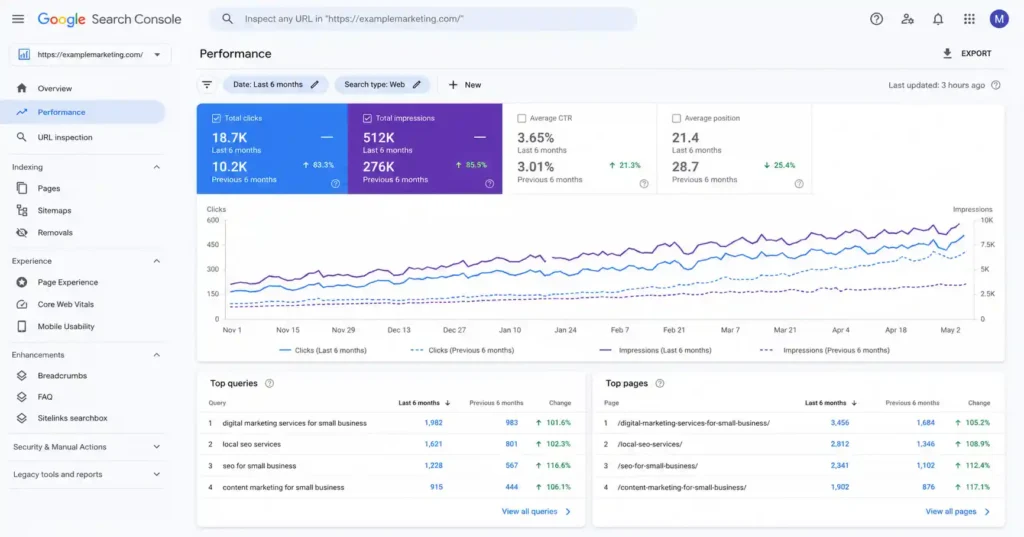
Add new examples, better headings, fresh screenshots, and improved internal links. - Track queries in Google Search Console
Look for pages with impressions but low clicks. Improve title, meta description, and opening answer.
If your goal is organic growth, this guide on how to increase website traffic without ads connects well with this strategy because it explains traffic growth without relying fully on paid campaigns.
Clear takeaway: SEO content is successful when each and every blog supports a business goal rather than when it is created only for the calendar.
What digital marketing strategies for small business are overrated?
All the same, the below-highlighted strategies-under the following circumstances; posting daily without a funnel, boosting random posts, chasing viral reels, buying cheap leads, and copying competitor campaigns without understanding their economics-are the most overemphasized and do engender false productivity that prevents a conversion-producing pipeline from being refined.
The counter-argument is that awareness matters. It does. But awareness without capture is wasteful for small businesses.
If someone watches your reel and leaves, what happens next? Do you have a follow-up system in place for those individuals who visit your website but still do not enquire? What do you do when someone asks for price on WhatsApp? Do you ever follow-up, or do you just lose their lead?
This is where many small businesses leak revenue.
A better approach is to build the minimum complete funnel.
- One offer
- One landing page
- One trust asset
- One enquiry method
- One follow-up sequence
- One reporting dashboard
Once the example and the page are larger than five, weekly short videos and WhatsApp follow-ups are far from being generic graphics to three random posts per day.
Clear takeaway: Activity is not strategy. A small business needs a conversion system, not just content output.
How do you measure if your digital marketing is working?
Key Performance Indicators in digital marketing, include inquiries, leads, lead conversion rates, cost per lead, repeat sales, and growth in organic traffic. Likes and shares are of no useful repute unless emotive connections are employed that combine with wider business-proven results.
Here is a simple scorecard.
| Metric | Why It Matters | Tool To Track | Review Frequency |
| Organic clicks | Shows SEO growth | Google Search Console | Monthly |
| Enquiries | Shows demand | Website forms or CRM | Weekly |
| Conversion rate | Shows page quality | GA4 or CRM | Monthly |
| Google reviews | Builds trust | Google Business Profile | Weekly |
| Email or WhatsApp replies | Shows nurture quality | Email tool or WhatsApp CRM | Weekly |
| Repeat customers | Shows retention | Billing or CRM data | Monthly |
Final thoughts on digital marketing strategies for small business
Digital marketing strategies for small business in 2026 should not be built around trends first. They should be built around customer behavior.
People search when they need answers. They compare when they need trust. They enquire when the offer feels clear. They buy when follow-up is strong.
It implies that your strategy needs to bind SEO credit, content, local visibility, reviews, email, WhatsApp, and conversion optimization into one simple system.
You need to begin with the channel closest to revenue. Improve the page. Build trust. Follow up better. Scale after that.
Clear takeaway: Small businesses do not need more marketing noise. They need a repeatable system that brings the right people and converts them consistently.