
Running a small business means wearing several hats at once. You might handle marketing in the morning, reply to customers after lunch. And stay up late preparing reports, all while trying to find time for sales and planning. The best AI tools for small business can lift some of that repetitive work off your plate. No tech team needed.
The useful question isn’t whether you should use AI. It is where artificial intelligence can actually save meaningful hours, sharpen your daily output, or help a lean crew accomplish something that once required hiring another person entirely. From writing and support to design, meetings, research. And basic automation, surprisingly practical options now exist for every single corner of an independent enterprise.
.
What Should Small Businesses Look for in an AI Tool?
Fancy features don’t mean a tool fits a small business. That approach fails. Better to nail down the exact task first, then hunt for software built for it.
Find things that are simple to pick up, slide right into your daily routine, and kill a headache you deal with constantly. Price hits hard too, particularly if your whole team needs logins.
A good AI tool should ideally help with one or more of these areas:
- Reducing repetitive manual work
- Creating or improving content faster
- Handling routine customer questions
- Summarizing information and documents
- Analyzing business data
- Automating simple workflows
- Improving sales and marketing productivity
Watch your privacy, too. Keep confidential customer details, passwords, money records. And sensitive business files entirely out of AI tools unless you actually know how that platform stores your data.
Best AI Tools for Small Business in 2026
There isn’t one AI platform that works equally well for every company. A local service business, an online store, and a small SaaS company may need completely different tools.
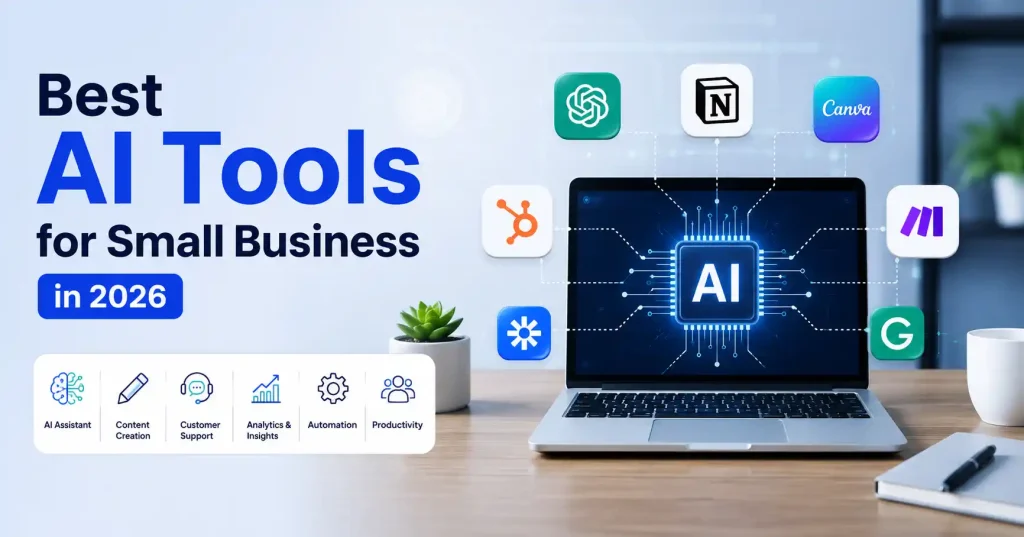
Here are some of the strongest categories and tools worth considering in 2026.
1. ChatGPT : Best General Purpose AI Assistant
Forget rigid tools, ChatGPT functions as a truly versatile partner. Small business owners rely on it constantly. They dream up fresh promotions, craft emails, untangle messy thoughts, summarize lengthy files, map out content, draft customer replies, or slice through data. Honestly, it handles whatever chaotic task you throw its way.Take a local marketing agency, for instance. They might feed the thing a messy client brief, get back a solid campaign framework. And then polish the tone before any human ever looks at it. Versatility is the real superpower here. Quality still hinges on your prompt and context though, Treat that initial reply as a rough draft, not the final word.
2. Microsoft 365 Copilot : Best for Microsoft Based Businesses
Your business already runs on Word, Excel, PowerPoint, Outlook, and Teams. Microsoft 365 Copilot slots right in without fuss. It drafts emails, summarizes long chats, throws together documents, crunches spreadsheets, and digs through messy data. Right inside the ecosystem. Huge, Currently, Microsoft has business plans ready for teams up to three hundred strong.
This works out well because employees literally live inside these exact Microsoft applications all day long. Rather than constantly bouncing around between a dozen random external platforms just to get things done, they stay put.
3. Canva Magic Studio : Best for Marketing Design
Most small shops need a constant stream of visual assets, social graphics, ads, posters, thumbnails, presentations, yet hiring an actual designer on staff rarely fits the budget.
That is where Canva steps in with smart automation. It won’t replace human taste or creative instinct, but it seriously cuts down routine production drag. Need to spin up early concepts, resize formats, write copy, or tweak old assets? It handles those parts fast.
Think about a local eatery, a solo consultant, an online shop, or a neighborhood plumber. They all need steady promo gear. With these tools, nobody starts staring at a blank canvas anymore.
4. Grammarly : Best for Business Writing
Clear writing matters everywhere.Grammarly catches clunky phrasing, grammar slip ups, awkward tone issues, and hidden weak spots across all your emails, proposals, and internal notes effortlessly.
For small teams, this is huge. Not everyone on staff is a seasoned copywriter. A salesperson bangs out a quick pitch, runs it through the tool to sharpen the clarity and polish the tone, and hits send. Done.
5. Notion AI : Best for Internal Knowledge and Productivity
Notion merges notes, project tracking, docs, and team knowledge into one hub, complete with artificial intelligence. Companies rely on it as their absolute single source of truth for meetings, workflows, and endless wikis.
Imagine a tiny five person agency where staff constantly repeat identical questions regarding client onboarding. A clean workspace stops that loop, Instantly. Meanwhile, built in AI summarizes long threads, hunts down buried details, or transforms messy meeting scribbles into actual action items.
6. Zapier : Best for AI Workflow Automation
AI gets genuinely useful the second it plays nice with the software you already open every day. Zapier ties those different business tools together, automating tedious workflows. Small teams can bounce data between systems instead of doing everything by hand.
Take a fresh lead filling out a web form. That single click can kick off a chain reaction: drop the contact straight into a CRM, ping the sales rep, set up a follow up task. And fire off a quick thank you email.
For small shops, automation matters. The point isn’t pushing out more output. It is about stripping away the friction from daily routines.
7. HubSpot : Best for AI Assisted CRM and Marketing
HubSpot suits smaller ventures seeking a unified engine for sales, marketing, and client management. Its AI capabilities tackle copy drafting, lead digging, and routine data chores. Yet feature access hinges entirely on your tier.
The true victory goes beyond automated writing. It traps client records and campaigns inside one locked ecosystem. No messy spreadsheets. No stuffed inboxes or scattered tools permitted anywhere near it.
How to Choose the Right AI Tool for Your Business
Don’t start by subscribing to seven AI platforms. Start with one repetitive task that consumes time every week.
Use this process:
- List repetitive tasks: Endless daily grinds demand emails, social posts, meeting notes, lead logs, reports, and customer questions. That never stops.
- Estimate the effort: Spot tasks draining your hours. They will truly drive you mad.
- Choose one tool: Target the platform solving your most expensive problem.
- Test it with real work: Look, test it for weeks, Never judge a tool by just a quick demo.
- Measure the outcome: Consider saved time, output quality, speed, or completed tasks.
- Expand carefully: Once one workflow works reliably, introduce another AI use case.
This trick halts widespread waste, stopping companies from completely funding neglected team software subscriptions.
How Small Businesses Can Use AI Without Losing the Human Touch
AI ought to take over the boring parts of a workflow, Meanwhile, humans stay on the hook for calls, facts, and talking to clients.
Look at customer support. AI writes drafts, sure, but a human has to vet the angry complaints. Marketing teams let AI spit out ideas, yet somebody who actually gets the brand picks what goes live. Business owners might read an AI summary of a report, but trusting every single finding blind? Bad idea.
Content works the exact same way. Machines crank out a rough draft fast. Real lived experience, specific examples, hot takes, and editorial common sense give business writing any actual value.
Organic growth is no different, AI can dig up keywords and oil the content machine. Still, small businesses need a solid digital marketing strategy to tie those tricks to real goals, rather than treating AI like a magic trick all by itself.
Common Mistakes to Avoid When Using AI
The biggest mistake is using AI simply because it’s available. If a task takes two minutes and already works well, automating it may not be worth the setup.
Other problems are more serious:
- Publishing AI generated content without fact checking it
- Giving AI access to sensitive information without reviewing privacy controls
- Buying multiple subscriptions before testing one workflow
- Using AI output without checking numbers, names, or business details
- Automating customer communication that really needs human judgment
- Measuring activity instead of actual business outcomes
AI should make your workflow simpler. If employees need complicated processes just to operate the AI system, you’ve probably chosen the wrong use case.
A Simple AI Stack for a Small Business
A practical setup doesn’t require dozens of apps. A small company might lean on one general AI assistant for drafting and research, an AI enabled design platform for marketing, a CRM to handle customers. And an automation tool to link repetitive tasks.
Take a small three person consultancy, for instance. They might fire up ChatGPT for rough drafts, grab Canva for a quick social graphic. Or lean on a basic CRM for leads. Then Zapier handles the follow up pings.
The right mix depends entirely on what your team already uses, If everyone lives inside Microsoft 365 all day, adding Copilot just makes sense. Why juggle a dozen random tools?
FAQ’s
What are the best AI tools for small business in 2026?
Choosing the right tool really depends on the task, ChatGPT’s a solid all rounder. Got a business already on Microsoft? Copilot makes sense. Canva’s great for marketing designs, obviously, and Grammarly will fix your writing. Internal work hums faster once Notion AI spikes output, Zapier automates grunt work, and HubSpot tackles CRM puzzles.
Can a small business use AI without hiring an AI expert?
Yes. Plenty of business AI tools target normal office workflows instead of technical teams. Pick a simple task to start with. Learn the tool as you go.
Are AI tools worth paying for?
Compare that monthly fee to the heavy lifting it saves your tired staff, that is, assuming the tool actually speeds up a core workflow.
Can AI replace employees in a small business?
Think of AI as a tool, not a replacement, Sure, it slashes repetitive tasks. But human judgment? Communication? Creativity? Accountability, those are still squarely on us.
How many AI tools should a small business use?
No ideal number exists. A few sharp tools beat a massive stack of subscriptions every single time, Honestly, keep it simple.
What should I automate first?
Begin with predictable tasks bearing clear outcomes. Meeting recaps, routine reports, draft emails, and data entry. These simple chores easily beat messy customer choices every single time when you start.
Conclusion
The top AI tools for small business rarely rely on endless feature lists. They slot seamlessly into daily operations and clear out an actual bottleneck.
Start small, Pick one recurring task, test a single tool, and track what shifts. Once that workflow runs smoother, then you can branch out into content, customer support, sales, reporting, or automation.
That is the trick. AI shines brightest when it hands a lean team extra hours to focus squarely on clients and those crucial choices that genuinely demand human judgment.
The point isn’t piling on more software. It’s building a leaner business by putting the right tools exactly where they belong.