
AI has crept into daily marketing tasks. Keyword research, ad copy, customer segmentation, social planning, campaign reviews. It is all there. The real question isn’t if marketers should adopt it. How do you actually use AI for digital marketing without losing your strategy, accuracy, or unique brand voice?
Done right, AI eats the repetitive stuff. It gets you past a blank page and into a rough draft at record speed. It crunches massive piles of data, pulls out trends, and chops one asset into a dozen pieces for various channels. Still, a human has to judge what matters. You decide what sounds believable and what actually goes live.
What Can AI Do in Digital Marketing?
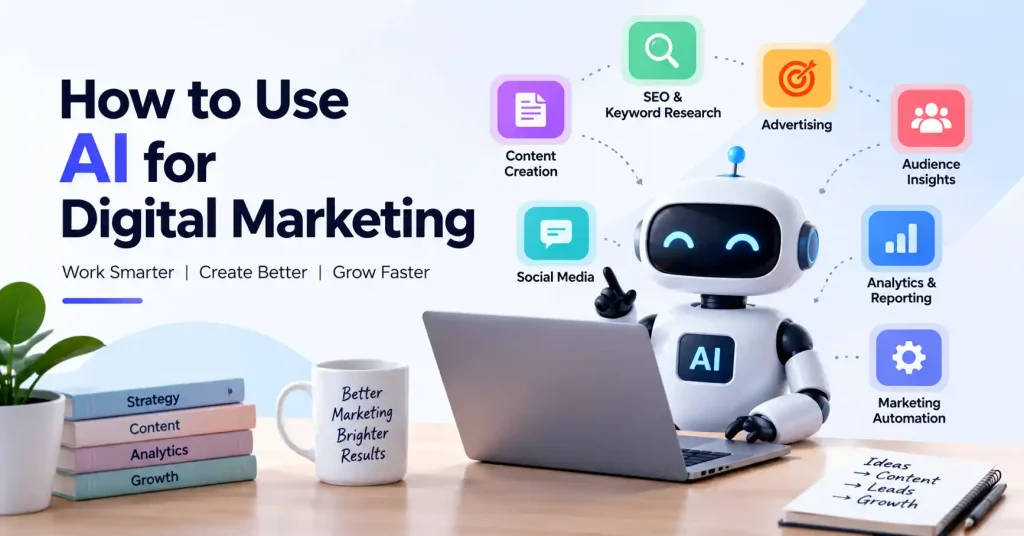
AI handles nearly every piece of a digital marketing workflow now. The real power isn’t in flashy tricks, but practical grunt work, Audience research, content generation, crunching campaign data, shifting tone, and wiping out repetitive chores.
Take a SaaS crew launching a fresh feature. They can lean on AI to sort customer feedback, pin down nagging pain points, sketch out positioning angles, spin up email drafts, and chop that launch copy into social snippets. Still, humans check and tweak everything before it actually drops.
Common applications include:
- Keyword and topic research
- Content briefs and outlines
- Blog, email and ad copy drafts
- Social media content
- Audience segmentation and personalization
- Campaign reporting and analysis
- Lead qualification and customer communication
- Content repurposing
- Marketing workflow automation
Artificial intelligence genuinely excels at hyper specific tasks. Hand it clean datasets, a repeating cycle, and swift human oversight, then watch it soar.
How to Use AI for Digital Marketing
AI works best baked right into your current marketing, not off to the side like some science project. Pick one bottleneck first. Test the new workflow. Does it actually save time or sharpen the work, Only then do you scale it up.
1. Use AI for Customer and Market Research
Marketers need to know what buyers care about before drafting content. AI sorts reviews, survey feedback, support tickets, sales notes, and competitor data into clear themes. It saves time.
Suppose a software company has hundreds of customer comments. Rather than reading every comment manually, a marketer can use AI to group them into themes such as pricing concerns, missing features, onboarding problems and integration requests.
The output isn’t the final market research report. It’s a faster way to spot patterns worth investigating.
2. Use AI for Keyword Research and Content Planning
AI can generate keyword variations, related questions, content angles and search intent categories. That makes it useful during the early stages of SEO planning.
For example, instead of asking an AI tool for “keywords about email marketing,” give it the audience, product, market and purpose. Ask it to separate informational, commercial and problem focused searches.
You can then validate the promising ideas with an SEO platform and actual search results. Our guide on how to use AI for SEO keyword research covers this workflow in more detail.
3. Create Content Faster, But Keep the Editor in Charge
AI can help marketers move past the blank pageIt churns out outlines, headline ideas, and fixes clunky drafts. Raw notes become polished work, shifting tone effortlessly. Still, posting that very first draft straight away? Bad idea.
AI may miss context, repeat familiar ideas or make claims that aren’t supported by the source material.
A better process is simple:
- Give AI the audience, goal, topic and relevant source material.
- Ask for an outline or several content angles.
- Select the strongest direction.
- Generate a working draft.
- Add original examples, experience and evidence.
- Fact check important claims.
- Edit the final piece for voice, usefulness and search intent.
The human editing stage is where generic copy becomes useful marketing content.
4. Repurpose Existing Content
AI shines brightest when it squeezes extra mileage out of stuff you already made. Take a deep dive SaaS article. Suddenly it is a punchy LinkedIn post, a quick thread on X, an email blast, a short video script. And a handful of FAQ prompts. The facts stay put. The wrapper just shifts to fit whatever channel you are hitting.
That is a lifesaver for lean marketing crews who never seem to have enough hours to build every single asset completely from scratch.
Our guide to the best AI tools for digital marketing covers tools that can support different parts of this workflow.
5. Improve Social Media Workflows
Artificial intelligence churns out hooks, captions, content calendars, and custom variations for different platforms. It takes a single campaign message and multiplies it into several posts, ensuring your marketing team never has to stare at a blank page again.
The trick is feeding the tool real context, A vague prompt gets you nowhere fast. Give it the exact audience, the specific product, the ultimate goal, the chosen platform, the precise tone, and your main message.
Imagine a B2B SaaS company wants to push a fresh analytics feature. They ask AI for three distinct LinkedIn angles. One teaches something valuable, one tackles a frustrating customer pain point, and one simply highlights the product. Then the marketer picks the winner.
6. Use AI for Paid Advertising
AI can assist with ad headlines, descriptions, creative concepts, audience messaging and variations for testing. Marketing platforms now bake AI straight into campaign creation tools. HubSpot, as a case in point, highlights AI text generation for Facebook, LinkedIn, and Google search ads.
The secret? Don’t view that machine made copy as the final word. Treat it as a pool of raw options. Your landing page, offer, audience and conversion goal should determine which version gets tested.
7. Analyze Marketing Performance
Marketing data is scattered everywhere. Analytics, ad dashboards, CRM software, random spreadsheets. It’s a mess. AI sorts through that noise, turning massive piles of numbers into questions you actually need to ask.
Ask questions such as:
- Which campaigns generated the most qualified leads?
- Which landing pages have high traffic but weak conversion?
- Which content topics consistently attract the right audience?
- Where did campaign performance change significantly?
AI spots patterns. Still, marketers need to check the raw data before moving budget or strategy. HubSpot uses marketing AI right now for audience segmentation, campaign analysis, and content planning. Always verify first.
Build a Simple AI Marketing Workflow
Ditch the heavy tech stack completely. Lean workflows just run smoother, demanding less effort while consistently delivering remarkably steady results every single time.
Try this seven step process:
- Define the goal: Decide whether you want traffic, leads, conversions, engagement or another measurable outcome.
- Collect context: Give AI your audience information, product details, campaign brief and relevant source material.
- Research: Use AI to organize questions, themes, keywords or customer feedback.
- Create: Generate several ideas, drafts or variations.
- Review: Check facts, brand voice, originality and relevance.
- Publish: Adapt the final asset to the channel.
- Measure: Compare results with the original goal and improve the next campaign.
This keeps AI tied to real business results. It does not let it drift into producing content all day.
Common Mistakes to Avoid
AI can make weak marketing processes faster, which isn’t necessarily helpful. If your strategy is unclear, generating more content won’t fix it.
Watch for these problems:
- Publishing AI output without meaningful editing
- Giving AI incomplete product or customer information
- Accepting unsupported claims as facts
- Creating large volumes of similar content
- Using the same messaging across every platform
- Sharing confidential business or customer information without checking data policies
- Measuring the number of assets produced instead of business results
Buying too many AI tools is a classic trap, Start with your workflow instead of shopping. When a single solid utility fixes the bottleneck, stacking three more on top just creates pure friction.
How to Measure the Impact of AI Marketing
The right metric depends entirely on what AI is doing for you. When it supports content creation, track real stuff like production time, engagement, and conversions instead of just counting published articles.
For automation tasks, look at hours saved and error rates. Advertising is straightforward. Just evaluate the standard campaign metrics you already rely on, including conversion rates, cost per acquisition, and return on ad spend.
Always ask one core question, Did the AI setup actually improve the marketing outcome?If an AI draft takes ten minutes to spit out but an hour to fix, efficiency is an illusion.
FAQ’s
Is AI useful for small digital marketing teams?
Absolutely. Small teams can plug AI into research, banging out content drafts, prepping social media, running reports, and all that grindy admin stuff. The real win? Less grunt work for people, not some magic button that handles all of marketing.
Can AI replace digital marketers?
AI handles solo marketing chores. Still, strategy needs people, you make the calls on positioning, audience, messaging, creative direction, and business goals. Most teams win big by using AI just as a workflow assistant, that is where the real value lives.
Can AI create SEO content?
Artificial intelligence handles outlines, research, drafts, and polishes text effortlessly, yet the final piece must still target search intent and truly aid readers. Fact check everything. Always demand real depth instead of bland, generic paragraphs.
How should marketers write AI prompts?
Spell out the exact audience, goal, and topic first. List your sources, tone, format, and limits. Do this clearly, Tweak that prompt whenever your very first try falls flat on its face.
What should marketers automate with AI?
Begin with the simple tasks that follow clear steps and are easy to check. Move into tasks like turning one piece of content into several forms, making quick data summaries, doing basic labeling or categories, and running routine planning sessions.
How can businesses avoid generic AI marketing content?
Write your own content and revise the draft a lot. Use customer stories, share what you know about the product, and include what you saw or heard yourself. Add any data you own. Also state your stance clearly. When you do this, AI has more solid material to use, and the final writing tends to sound more like you.
Conclusion
Using AI for digital marketing doesn’t mean turning your entire strategy over to some bot. That is a mistake. It is about sniffing out those grinding, repetitive chores in your daily workflow where software can actually lend a hand.
Pick just one job to start with. Content research works, or maybe social media repurposing, keyword grouping, or pulling campaign reports together. Feed the machine enough context. Then check what it spits out, and look closely at whether your numbers actually get better.
The people who win big with AI aren’t necessarily running twenty different tools at once. Not at all. They just know what to automate, what needs a human touch, and where smarter workflows buy them time for real work.