
When people decide to learn digital marketing they usually start by searching for the best course, and a few weeks later they end up getting overloaded with SEO , Google Ads, email marketing, analytics, AI tools , social media, and dozens of certifications too.The real issue is not the lack of resources, it’s the lack of direction.
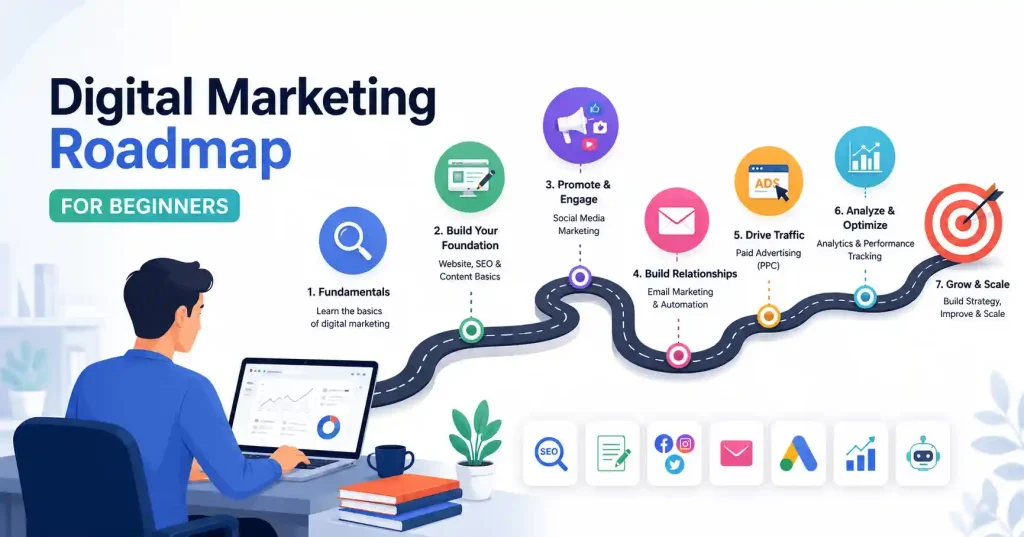
A solid digital marketing roadmap isn’t about absorbing everything at once. It’s about seeing how each channel works together, and building hands-on ability step by step. If you’re just starting out, this guide should help you focus on what actually matters, rather than bouncing between random tutorials .
Why You Need a Digital Marketing Roadmap
Trying to learn every marketing discipline at the same time usually turns into frustration, I have seen it happen. Beginners will spend months watching videos and never apply anything they learned, and then they wonder why nothing moves. Real progress comes faster when you follow a learning trail that is structured, and not random.
Digital marketing is a mix of multiple connected skills. SEO helps people stumble upon what you put out, social media builds awareness, email marketing strengthens long term ties, and paid advertising can speed up expansion. When you understand how these pieces cooperate, learning can feel more straightforward, even if at first it seems a bit scattered.
If your goal is eventually driving free traffic to a website, our guide on How to Increase Website Traffic Without Ads is an excellent next step after learning the fundamentals because it explains practical strategies you can start applying immediately.
Step 1: Learn the Fundamentals of Digital Marketing
Before you pick a specialization, take a moment and understand the main marketing channels and what they bring to business growth. See how each channel, even the quiet ones, supports sales and awareness , so you can make better decisions later.
Focus on learning:
- Search Engine Optimization (SEO)
- Content Marketing
- Social Media Marketing
- Email Marketing
- Pay-Per-Click (PPC) Advertising
- Analytics
- Conversion Optimization
Don’t worry too much about trying to master every topic right away. Your first goal is to understand what each channel does, and when businesses use it, because this helps you later.
Step 2: Build a Basic Website
Reading about digital marketing is useful, but practicing on your own website teaches far more than any course really. You can create a simple WordPress site or personal blog, and then mess around with SEO, publish articles, drop in analytics tools and see how pages actually perform. In search engines, you learn faster when you can watch what changes do.
Also, making mistakes on your own website is one of the fastest ways to get real hands on practice, so dont worry too much about making everything perfect at first, you know.
Step 3: Learn SEO Before Paid Advertising
A lot of beginners jump pretty fast into paid advertising, because it promises outcomes that look quicker and more straightforward, while SEO can feel slower at first. Even so, SEO teaches really useful skills like figuring out what people actually mean when they type searches, how the content should be structured and phrased, how to discover and check keywords, and even how visitors experience the website. Those abilities then spread into every other piece of digital marketing, so everything becomes stronger each time around.
Start with topics such as:
- Keyword research
- On-page SEO
- Technical SEO
- Internal linking
- Content optimization
Before publishing your own content, reviewing an On Page SEO Checklist can help you avoid common optimization mistakes and improve your chances of ranking in search results.
Step 4: Learn Content Marketing
Content marketing sits at the middle of almost every winning digital marketing strategy, it’s really where most of it flows from. Whether you’re drafting blogs, building YouTube videos, sharing LinkedIn posts or sending newsletters, you’re producing content, over and over again.
Good content answers questions.
It solves problems.
It builds trust before asking for a sale.
One thing ive noticed over the years is that beginners often focus way too much on writing for search engines. In real life the best performing content usually reads like it was penned for people first, not for bots, not for rankings. If you chase the algorithm too hard, you end up with text that feels a little off even when the keywords are perfectly aligned.
Step 5: Understand Social Media Marketing
Social media isn’t only about throwing up good looking visuals or such.
Each platform brings in different people, and it ends up supporting different business objectives.
Instagram seems strong when you have a visual brand , the whole feed vibe helps.
LinkedIn tends to work better for B2B companies , especially when the content is about expertise or partnerships.
Facebook still holds value for local communities too , because groups and neighborhood pages keep moving.
Rather than chasing mastery everywhere, pick one or two channels, then spend time understanding how audiences actually respond to posts there.
Step 6: Learn Email Marketing
A lot of marketers underestimate email marketing, because it never gets the same, immediate attention as social media seems to get.
Even so, email keeps on helping businesses build more lasting , longer term relationships with their current customers, you know those people who already trust them.
Start by understanding:
- Email list building
- Lead magnets
- Welcome sequences
- Newsletter creation
- Email automation
Learning how email supports the customer journey gives you another valuable marketing skill.
Step 7: Understand Analytics
Publishing content without measuring results is like driving without looking at the road.
Learn how to interpret basic marketing metrics.
Focus on:
- Website traffic
- Organic search performance
- Engagement
- Bounce rate
- Conversion rate
- User behaviour
These insights help you make better decisions instead of relying on guesswork.
Useful Digital Marketing Tools for Beginners
You don’t need dozens of expensive subscriptions while you’re learning.
| Tool | Purpose | Beginner Friendly |
| Google Search Console | SEO performance | Yes |
| Google Analytics | Website analytics | Yes |
| Canva | Graphic design | Yes |
| WordPress | Website management | Yes |
| Mailchimp | Email marketing | Yes |
As your experience grows, you can explore more advanced SEO, automation, and advertising tools.
Build a Portfolio Along the Way
A mistake beginners often make is gathering certificates without getting real hands on experience, like you can’t just stack credentials and call it learning.
Employers and clients usually care less about the course title, more about what you’ve actually done in practice, and whether it shows.
Document your work.
Publish blog articles.
Improve your own website.
Run small campaigns.
Measure the results.
A portfolio showing real projects usually speaks louder than a long list of certifications.
Common Mistakes Beginners Should Avoid
Some mistakes appear repeatedly among new marketers:
- Trying to learn everything simultaneously.
- Copying competitors without understanding why something works.
- Ignoring analytics.
- Focusing only on social media.
- Expecting immediate results.
- Never applying what they’ve learned.
Digital marketing rewards experimentation.
Some campaigns perform well.
Others don’t.
Both outcomes teach valuable lessons.
If you’d like another perspective on building practical marketing skills, the HubSpot Marketing Blog regularly publishes beginner-friendly articles covering SEO, content marketing, email marketing, AI tools, and digital strategy that complement the concepts discussed here.
Frequently Asked Questions
How long does it take to learn digital marketing?
Most beginners pick up the basics within a few months , but actual know how takes time and keeps growing through steady practice, learning routines, and real-world projects.
Should I learn SEO or social media first?
SEO is usually a better starting point, because it teaches search intent, helps with making content, and pushes website optimization that in turn support many other marketing channels, you know it connects with everything.
Do I need a marketing degree?
No, a lot of successful digital marketers are self taught through online learning plus practical experience, you know, it ends up being that way.
Which digital marketing skill is most valuable?
There is no single answer, SEO and content marketing, and paid advertising too they all tend to work together. Along with analytics , and then email marketing, they complement each other in a kind of loop, not fully straight, just cooperative.
Should I buy expensive courses?
Not right away. Free resources, official documentation, and practical know how can really lay a solid foundation before anyone invests in paid training.
Is digital marketing a good career?
Yes, businesses of every size rely on digital marketing, to reach customers, it’s pretty much a valuable long term career path.
Conclusion
A successful digital marketing roadmap isn’t really about trying to learn every platform, or collecting dozens of certifications, in a row. It’s more about building one practical skill step by step, then actually using it, and slowly realizing how every marketing channel links back to business growth. Start with the fundamentals, build your own little projects, track your results, and keep refining. In time, those small consistent actions turn into real experience, the thing that separates confident digital marketers from people who only know the theory , but never practiced it.