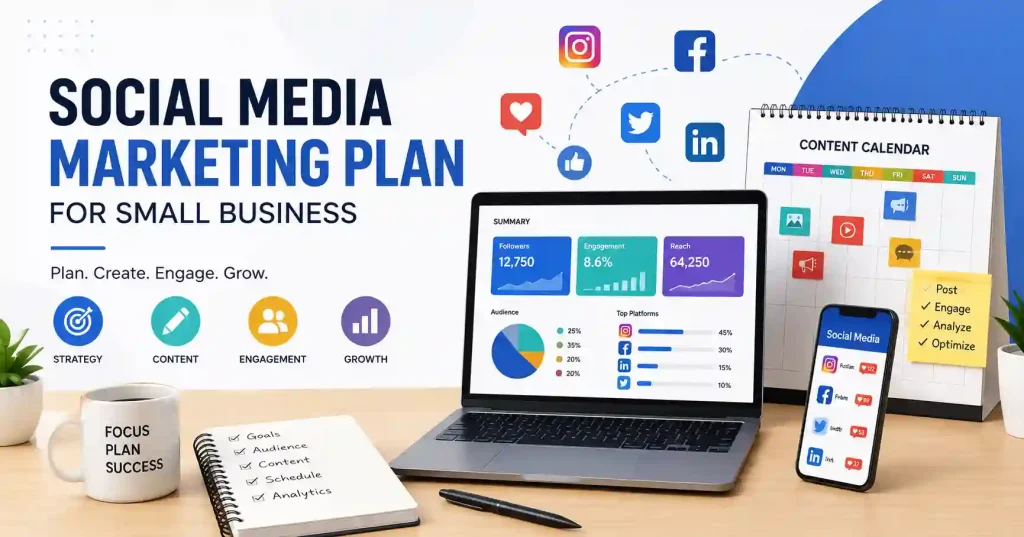

Starting a social media account is easy. Making it actually bring in customers in a steady way is where most small businesses, you know, hit a wall.
I’ve watched local businesses share something every single day for months, and still see very little engagement, while other spots post less often but get regular enquiries. Usually, the gap is not the platform or the budget. It is more about having a clear social media marketing plan.
A solid plan gives each post a job. Instead of posting whenever you remember, you are building content that supports your business targets, connects with your audience, and nudges potential customers toward choosing you, even if they are not ready today.
No matter if you’re working a local service, running an online store, or building a startup that’s growing, this guide will help you put together a handy social media plan that actually performs.
Why Every Small Business Needs a Social Media Marketing Plan
Posting randomly, rarely gives consistent outcomes. If there is no real plan, it is easy to repeat the same message, overlooking key openings, or waste hours building posts that do not actually align with your business aims.
A structured social media marketing plan helps you:
- Maintain a consistent brand presence.
- Create content that serves a purpose.
- Reach the right audience.
- Build trust with potential customers.
- Measure what’s actually working.
Think of it like running a marketing campaign instead of simply maintaining a social media profile.
Step 1: Define Clear Business Goals
Before designing graphics or writing captions, decide what success looks like.
Different businesses use social media for different reasons.
For example:
- Generate qualified leads
- Increase website traffic
- Build brand awareness
- Drive online sales
- Improve customer engagement
- Build a local community
A local interior design company can end up spending most of its time on pulling in consultation requests, while an eCommerce brand may try to push product sales more frequently.
Your content should always align with one of those purposes.
Step 2: Understand Your Target Audience
One mistake I often notice is businesses trying to speak to everyone.
That usually means they connect with no one.
Start by answering a few simple questions:
- Who are your ideal customers?
- Which platforms do they use?
- What problems are they trying to solve?
- What type of content do they already engage with?
If your audience spends most of their time on Instagram and Facebook, investing heavily in another platform might not give the best return , because the attention is already there, you ‘know.
Also once you know your audience it becomes easier to craft captions, visuals, and offers that feel relevant, not generic.
Step 3: Choose the Right Social Media Platforms
Not every platform deserves your attention.
It’s often better to manage two platforms well than six poorly.
Here’s a simple comparison:
| Platform | Best For |
| Local businesses, communities, lead generation | |
| Visual brands, lifestyle businesses, products | |
| B2B services, SaaS, professional networking | |
| X (Twitter) | Industry updates, thought leadership |
| YouTube | Tutorials, product demonstrations, educational content |
Pick your platforms by noticing where your customers are already hanging around, rather than where everyone else is posting.
Step 4: Build Content Pillars
One reason businesses run out of ideas is that every post keeps starting from scratch, and it feels repetitive in a way that is hard to say plainly.
Instead, set up a handful of ongoing content categories you can cycle through, again and again, so the production stays calmer and more steady.
For example:
Educational Content
- Answer common customer questions.
- Share quick tips.
- Explain industry concepts.
Behind-the-Scenes
- Show your workspace, team, or daily operations.
- People enjoy seeing the human side of a business.
Customer Success Stories
- Share testimonials, before-and-after results, or client experiences.
- Social proof often builds more trust than promotional posts.
Promotional Content
- Talk about offers, products, or services but don’t make every post a sales pitch.
- A healthy mix keeps your audience engaged.
Step 5: Create a Simple Posting Schedule
Consistency matters more than frequency.
A little business that shares three meaningful posts each week seems to do a bit better than another one that publishes three times a day with minimal planning, and not much preparation at all. It feels almost like steady rhythm beats rushing every time, even if the other one is more frequent.
A simple weekly schedule might look like this:
| Day | Content |
| Monday | Educational tip |
| Wednesday | Customer story |
| Friday | Product or service highlight |
| Saturday | Behind-the-scenes |
Planning a month of content in advance also saves time and reduces last-minute stress.
Step 6: Create Content That Encourages Engagement
Many businesses focus only on publishing.
Successful businesses focus on conversations.
Instead of simply describing your product, encourage interaction.
For example:
- Ask opinions.
- Run polls.
- Share quick quizzes.
- Request customer experiences.
- Encourage comments.
Small interactions, over time, help you form stronger relationships with your audience.
If you want more ideas for boosting engagement and keeping a steady posting rhythm, HubSpot’s Social Media Marketing Guide shares practical techniques that businesses of all sizes can use to reinforce their social media visibility.
Step 7: Track What Actually Works
One of the biggest advantages of digital marketing is measurable performance.
Don’t rely on assumptions.
Monitor metrics like:
- Reach
- Engagement rate
- Website clicks
- Profile visits
- Lead enquiries
- Conversion rate
After a few months, you’ll usually notice patterns.
Perhaps educational posts generate more website traffic.
Maybe customer success stories produce more enquiries.
Those insights should shape your future content.
Social media is, like, a strong way to build brand awareness, but it should not be your only source of traffic, period. If you also want to pull visitors in through search engines, go through our guide on How to Increase Website Traffic Without Ads, where we describe practical ways to grow steady organic reach while you keep pushing your social media work.
Common Mistakes Small Businesses Should Avoid
Even well-designed strategies can fail because of a few common habits.
Some examples include:
- Posting only promotional content.
- Ignoring comments and messages.
- Copying competitors instead of developing a unique voice.
- Using inconsistent branding.
- Chasing every trending topic.
- Giving up after only a few weeks.
Another mistake is forgetting that social media supports your wider digital marketing strategy, you know.
Your website , blog, SEO, and social channels should all work together, more or less, without fighting each other.
For instance, posting practical blog articles gives you solid material to distribute across social platforms. It also boosts your search visibility. If you are still laying down your SEO foundation, our On Page SEO Checklist can help make sure your content is tuned up before you begin promoting it.
Useful Tools for Managing Your Social Media Marketing Plan
You don’t need expensive software to stay organized.
Several affordable tools can simplify planning and publishing.
| Tool | Purpose |
| Meta Business Suite | Schedule Facebook and Instagram posts |
| Canva | Design social media graphics |
| Buffer | Schedule posts across platforms |
| Trello | Content planning |
| Notion | Editorial calendar and collaboration |
If you are looking for platform specific best practices , Meta’s official Business Help Center gives pretty detailed guidance on how to build, schedule, and handle content across Facebook and Instagram, so you can keep everything running without a lot of guess work.
FAQ’s
How often should a small business post on social media, really?
You do not need to post every day. Quality beats volume, three to five valuable posts each week is usually enough for most small businesses and maybe even a bit more in busy seasons.
Which social media platform is best for local businesses, in practice?
Facebook and Instagram are still the best bet for most local businesses. They have a large audience and strong local targeting options, so reaching nearby customers feels easier.
Should every post promote my business
No, not every time. A good content blend includes educational posts, light entertainment, and community oriented updates along with promotional content sometimes and not every single day. If it looks like an ad, people will tune it out.
How long does it take to see results
For organic growth, expect several months. If you stay consistent, you will usually notice gradual improvements in engagement and enquiries over time, then it starts to compound.
Conclusion
A successful social media marketing plan is not really about posting every day, or running after the newest trends , it’s about getting what your audience needs, making content that actually helps them, and keeping at it consistently over time.
First, set goals that are clear, then pick the platforms that really matter to your customers , not the ones that just look shiny. After that, create a content calendar you can manage without burning out. You should review what is happening, measure the outcomes, tweak your plan using actual numbers, and keep in mind that social media performs best when it fits inside a bigger digital marketing system.
With a careful plan and steady execution , a small business can still build a connected community, reinforce its brand identity, and drive real business growth, even without a huge marketing budget.